
Authenticity Is Not Total Exposure: The Truth About Personal Branding and Ethical Influence
Jan 24, 2026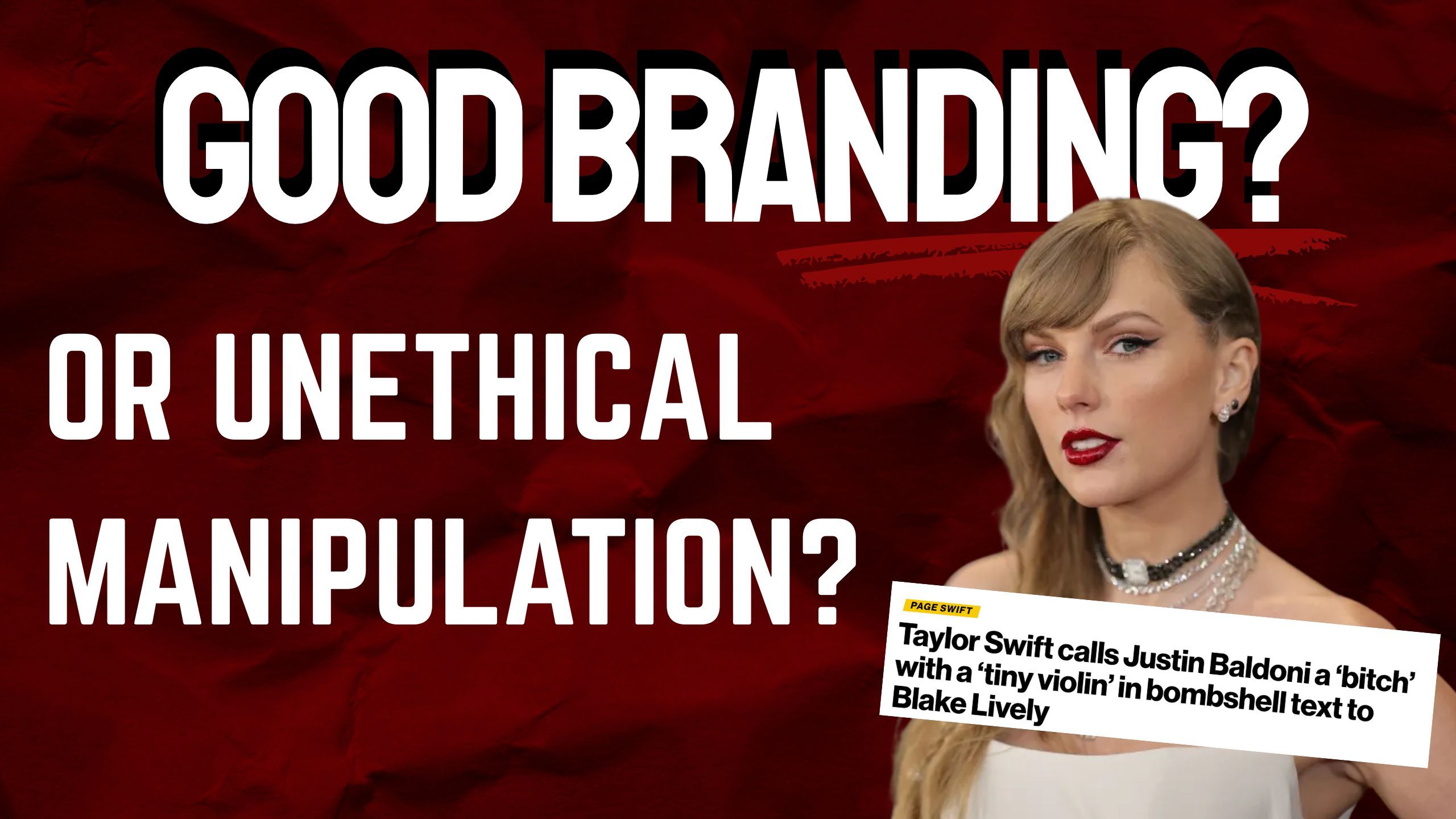
“Just be authentic.”
That line has probably done more damage to modern brands than bad logos ever could.
After Taylor Swift got dragged into headlines for bully behaviour and mean girl text messages I received some messages saying: “This is proof that you should always be authentic in your brand”. As if, maybe, she should have built a brand off being a bully that helps conspire to take down people that stand in her way (although her way of publicly dragging ex boyfriends for their secret struggles with depression & drugs should have been some sort of tell).
Yet, the question itself is the tell.
Because underneath it is a belief so sloppy it’s almost impressive: that authenticity means total exposure. That your brand should contain all of you. Every thought. Every contradiction. Every unprocessed truth.
That belief isn’t noble.
It’s reckless.
And it’s why so many people torch their credibility in the name of being “real.”
The bigger problem? This is often taught by people “helping” people with their branding. Ouch.
A Necessary Boundary Before We Go Further
I’ve used Taylor Swift as a case study when teaching branding psychology for years. And before this analysis goes any further, something needs to be made explicit: with power comes responsibility.
Branding psychology is a tool. Like any tool, it can be used to empower—or to manipulate. This article addresses brand construction, not moral exemption. Strategic curation does not justify unethical behaviour, nor does brand insulation absolve anyone from accountability.
Any conduct currently being surfaced—whether through private messages or allegations connected to the Vanzam lawsuit—exists in a separate category altogether. Understanding how a brand is built does not excuse how power is wielded.
Two conversations can exist at once.
This article speaks to one of them.
Taylor Swift Did Not Accidentally Build This Brand
Taylor Swift didn’t trip and fall into one of the most powerful, insulated brands on the planet.
She architected it from the beginning—arguably before there ever was a “day one.” Even her name was a strategic decision. “Taylor,” intentionally unisex, was chosen to neutralize gendered assumptions and quietly widen the range of rooms she could enter without friction. That choice alone signals something important: this was never a naïve rise. It was a considered one.
Her mother, who had experience in marketing, understood early what most artists learn too late—that talent without positioning is fragile. Together, they shaped a brand that could occupy a specific cultural niche while still leaving room to expand. The early curation wasn’t about suppressing who Taylor was; it was about identifying which parts of her identity could translate, connect, and scale in a highly competitive industry (then you could argue make up the rest… but that is for another day!).
That level of foresight also explains her brands durability. Brands that last are rarely accidental no matter who you are & how big your name —they’re built by people who understand the difference between self-expression and strategic expression long before the audience ever notices.
Taylor Swift has had discipline. The discipline to curate, refine, and protect a brand container that actually works. Her brand isn’t built on chaos or confession. It’s built on emotional resonance, narrative continuity, and archetypal familiarity (the everywoman brand archetype).
She didn’t sell “access to everything”, although her vulnerable songs may give it that impression.
She sold recognition.
There’s a difference.
And within that difference lies why the ruthless business woman, the scheming friend, and ruler chess moves never make it into the brand — It has literally no place.
Your Brand Is a Role, Not Your Entire Identity

Here’s the part people resist admitting because it collapses the fantasy they’ve built around “being authentic”: we already live as contextual beings. You do not show up the same way with your closest friends as you do at the office or the same way in private pain as you do in public leadership. This isn’t deception—it’s function. It’s discernment. It’s how psychologically intact adults move through the world.
A brand that builds the foundation for your business is simply one of those contexts—a role you consciously step into. It is not your entire identity, not your inner chaos, not your unprocessed emotional landscape, and not your every thought made public.
The mistake happens when people confuse this is a real part of me with this must be the totality of me. That confusion is where coherence dissolves, trust erodes, and brands begin to collapse under the weight of their own indiscretion.
Authenticity Is Not Total Exposure & Discernment is not Self Betrayal
The internet has quietly turned “just be authentic” into a hall pass for zero strategy or intentionality. It rewards immediacy over discernment and visibility over coherence, encouraging people to mistake exposure for integrity. Context disappears. Containment is dismissed as inauthentic. Responsibility is reframed as censorship. What’s left is a culture of vibes and oversharing, routinely dressed up as courage, even when it erodes trust rather than building it.
But here’s the truth few people want to say out loud: not every truth deserves a platform. A truth can be emotionally real and still irrelevant to the function of a brand. In fact, indiscriminate honesty often weakens a brand’s signal, flooding the narrative with noise that confuses the audience rather than clarifying the promise. Relevance matters more than revelation. Strong brands are not built through exposure; they’re built through selection—the disciplined choice of which truths serve the brand’s purpose and which belong elsewhere.
Emotional Discipline is a Glorious Gift ( in all realms of life)
One of the most damaging sleights of hand in modern authenticity culture is the refusal to distinguish between self-censorship and discernment.
Self-censorship is fear-based: the silencing of truth to avoid consequence, rejection, or discomfort. Discernment is values-based: the intentional choice to express what is relevant, responsible, and aligned with purpose. One erodes integrity. The other preserves it.
The internet collapses this distinction and then acts surprised when brands unravel. Any restraint is framed as repression. Any boundary is labeled inauthentic. But not everything left unsaid is suppressed—some things are simply selected out. And selection is not betrayal; it is leadership. Brands rarely collapse because people are too contained. They collapse because no one taught them how to choose.
Why Taylor’s Brand Will Survive This
At this time I do not see Taylor Swift’s brand being taken down by the texts messages revealed in the Justin Baldoni & Blake Lively case. It isn’t the first time Taylor has been accused of being a mean girl or bully. The reality is that anything that doesn’t align with Brand Taylor—the machine that has been meticulously built over decades—is either suppressed, eliminated, or reframed. Not necessarily through overt force, but through narrative control, strategic silence, and the quiet redirection of attention through charity visits, donations, releases, and awards. This is how powerful brands protect coherence. They don’t respond to every disruption; they absorb, contextualize, or neutralize it.
What’s important to understand is that this didn’t happen by accident. The branding itself made it nearly incomprehensible to her supporters that she could ever step “out of line” in the first place. When a brand is constructed tightly enough, the audience doesn’t just defend it—they can’t cognitively reconcile information that contradicts it. The mythology does the work long before the PR machine has to.
This is precisely why Taylor Swift will likely walk through the current controversy largely untouched.
Her brand promise was never, “I show you everything.”
It was, “I help you feel seen.”
Those are radically different contracts.
And in a brand that always has an enemy to fight her brand conditioned her audience to see the other person as the problem regardless of what her texts say.
The Everywoman archetype she embodies lives in the creative and emotional arena of her life—not in the totality of her power, strategy, or relationships. That boundary isn’t accidental. It’s structural. And it’s the reason the brand has durability under pressure.
You can—and should—critique how power operates within that structure without pretending the brand was ever something it wasn’t. Understanding the architecture doesn’t require defending the behaviour. It simply requires intellectual honesty about what the brand was designed to do—and how effectively it does it.
Where the Ethical Line Actually Is

Now this is where the conversation gets uncomfortable—and where it actually applies to everyone, not just celebrities with massive platforms. Because the moment you understand what goes into building a brand, you are no longer “just expressing yourself,” regardless of your audience size. You are shaping perception. You are influencing attachment. You are participating in power dynamics the second someone listens, follows, or trusts what you say.
Ethical responsibility doesn’t begin at scale. It begins at intention.
Whether you’re launching your first podcast, building a personal brand from scratch, or operating at Taylor Swift–level influence, the same principle applies: branding psychology has impact. It shapes how people see themselves, how they interpret reality, and how they attach meaning to your message. That power can be used to empower—helping people orient, clarify, and self-author—or it can be used to manipulate, consciously or not.
This is where lines get crossed, and not only by celebrities. Blurring emotional intimacy with audience trust. Leveraging relatability to create dependency rather than agency. Allowing mythology—personal or brand—to replace accountability. These patterns show up everywhere, just with different levels of visibility.
And again, naming this does not require moral theatrics. It doesn’t require calling anyone fake, evil, or corrupt. It requires maturity. A brand can be authentic within its lane and still warrant scrutiny for how its influence operates. Responsibility is not a punishment for success; it’s the cost of leadership at any level.
Nuance isn’t weakness.
It’s the baseline.
If you are building a brand—any brand—you are shaping more than content. You are shaping context. And context changes how people relate to themselves and the world around them. That deserves care. Ethics in branding isn’t about scale; it’s about stewardship.
Oversharing and the Cult of “Brave Truth”
This same dysfunction plays out every day at the creator level, where confession has been rebranded as courage and shock has been mistaken for integrity. Somewhere along the way, we decided that the most uncomfortable truth must also be the most honest one—and that anything less than total exposure is evidence of fear.
It isn’t.
Oversharing is often not bravery at all, but uncontained shadow looking for applause. It’s the externalization of material that hasn’t been metabolized yet, released into the public sphere without structure, context, or responsibility. The result may feel raw, but raw does not mean coherent—and it certainly doesn’t mean trustworthy.
Without a clear brand engine—without understanding why the brand exists, what tension it’s meant to resolve, and what transformation it’s actually here to facilitate—truth becomes indiscriminate. Everything gets shared because nothing has been prioritized. And indiscriminate truth doesn’t deepen trust; it destabilizes it. It confuses the audience, erodes narrative clarity, and shifts the relationship from leadership to emotional volatility.
A brand is not a diary.
It is not a confessional booth.
It is not a public processing space.
A brand is a signal—deliberate, directional, and designed to orient the people who encounter it. When that signal dissolves into emotional sprawl, what’s lost isn’t authenticity. It’s authority.
Why Brand Archetype and Structure Are Non-Negotiable
Archetypes aren’t costumes or aesthetic choices. They are containment systems—structures that give a brand coherence, limits, and internal logic. An archetype doesn’t just influence how a brand looks or sounds; it determines which truths belong inside the brand, which truths are held back until they’re relevant, and which truths never enter the brand at all.
This kind of containment isn’t restrictive. It’s clarifying. It allows a brand to express something real without becoming indiscriminate or unstable. Archetype provides the context that turns authenticity into signal rather than noise.
When you layer in precision tools like BG5, that containment becomes surgical. You can see exactly where someone’s voice naturally cuts through—where expression builds trust and authority—and where unintegrated shadow leaks into the brand under the banner of “honesty.” That distinction is what separates resonance from volatility.
This is how brands stand out without self-destructing: not by saying more, but by saying what belongs. This Isn’t Manipulation. It’s Maturity.
-
Boundaries are not deception
-
Strategy is not manipulation
-
Curation is not lying
Authenticity is not showing everything.
It’s sharing the right truths, in the right arena, for the right reason.
That’s not selling out.
That’s building a brand that is the foundation of your business.
And the sooner we stop confusing exposure with integrity, the fewer people we’ll watch burn their own brands down while calling it “being real.”
The Paradox of Authenticity
The paradox of authenticity is that it requires restraint. Not fear-based silence, but intentional choice. Not self-censorship, but self-leadership. The strongest brands understand this instinctively. They don’t expose everything—they express what belongs.
Archetype gives that expression shape. Structure gives it durability. Ethics give it legitimacy.
Authenticity is not total exposure.
It is truth, placed inside the right container.
And without that container, even the real thing collapses under its own weight.
I write about the psychology of branding, narrative power, and media influence on substack. Think of this as a glimpse into the workings of my mind, and how I think, before it turns into podcasts or digestible bits of content for social media. If you enjoyed this piece, I welcome you to subscribe to my substack HERE.
ashley
Outlaw Media Co.
