
Perfectionism Is Nervous System Protection That Prevents Alignment
Jun 24, 2026
There’s a moment I keep meeting in my work with Human Design, the Nervous System, & high performers. Maybe you can relate.
I’ll be walking someone through their design — someone brilliant, accomplished, whose whole life is a wall of evidence that they are not, and have never been, a failure. And I’ll say one phrase: Your profile is based on trial and error. And they flinch. Their whole body changes. I can see it immediately. They say some version of: “I agree with everything you’ve said so far. But not that. I don’t fail at things.” And the people who react to those two words most violently are almost always the most successful people in the room.
That flinch isn’t a disagreement. It’s a doorway. And to understand what’s behind it, I have to tell you how I think about change itself — because it’s the thing underneath everything I teach.
Note: While this article was more specifically written for the 3rd & 6th line profiles in Human Design all human beings go through trial and error. Therefore, if you are not a 3rd or 6th line in Human Design I encourage you to still read the article. I am confident wisdom is waiting for you here.
You Cannot Save a Tree with Flooded Roots by Cutting Branches
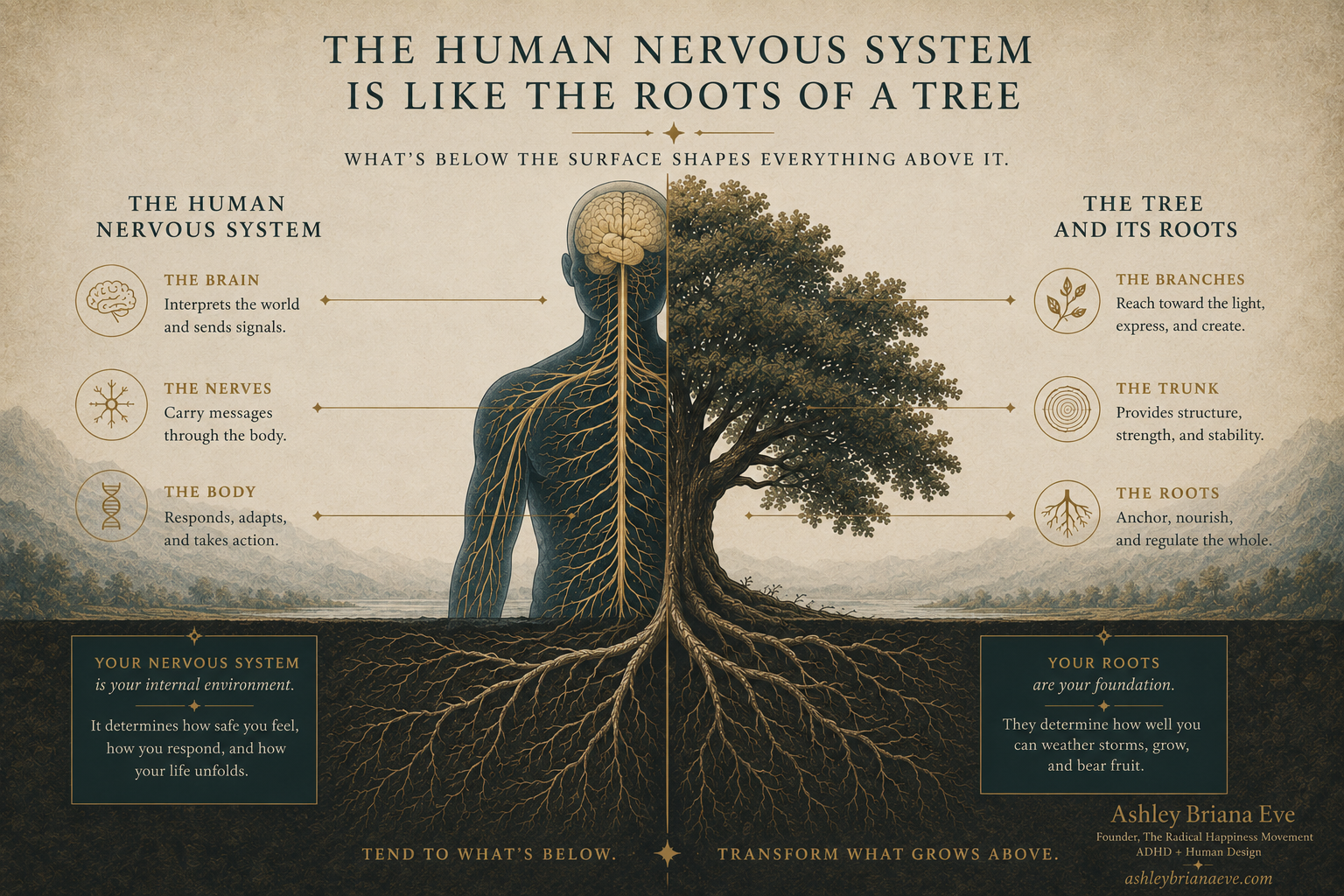
Before we get to the Human Design piece we are going to set the stage with the nervous system. I work from a framework I created called The Root System. It comes down to one law:
Behaviour defaults to identity. Identity defaults to the body. And the body was shaped by the soil it was planted in.
Picture a tree. The branches and fruit are your behaviour — what you do, what you produce, how you show up. The trunk is your identity — the single load-bearing column that everything visible grows out of. The roots are your nervous system — and here’s the part that stops people: a nervous system actually looks like the root structure of a tree. The dendrites, the branching neurons, spreading underground out of sight. And the soil is your environment — what you were planted in. Family, culture, the early conditions that shaped everything that grew after.
Almost every change framework on earth works at the branch level. Habit stacking, accountability, discipline, productivity systems. Prune here, reshape there. And a smaller, smarter set of frameworks goes one layer deeper, to identity — become the kind of person who does the thing. That’s real progress. But it still stops short.
Because here’s what I’ve come to believe from a past as a mental health counsellor and over 7 years mentoring high performers using Human Design and their nervous system: if a tree is sick because it’s planted in toxic soil, cutting the branches will not save it. You can prune the behaviour. You can reshape the canopy. But until you tend the soil and the roots — the environment and the nervous system drawing from it — the tree keeps producing the same fruit. Not because it’s weak. Because it’s responding accurately to what it was planted in.
And here’s the hope inside that: you can’t undo the soil you were first planted in. But you can tend the soil now — add fertilizer, change the water, amend what’s depleted, change what you let grow around you. You can’t re-plant your childhood. But you can tend what grew from it.
This matters enormously for what we’re about to talk about. Because the high performer’s flinch at “trial and error” looks like a mindset problem — a branch. It feels like an identity problem — the trunk. Or it may even appear to be a Human Design problem — the “trial and error” doesn’t fit. But it lives, like everything does, down in the roots and the soil they draw from.
The two faces of trial and error
I want to be upfront: Every human goes through trial & error. We are all meant to learn from our experiences, and we cannot learn from our experiences if they are only positive. High performers, however, tend to develop identities around control, perfectionism, & certainty which leads to an illusion of there having been no trial & error because they simply figured it all out to prevent it.
Oh, the illusion of control! And something I asked a new client recently: What if the control itself is the trial & error and it’s time to take the lesson & move on?
With that said, in Human Design we have something called the “profile” or “public role”. You can watch me explain it in depth in the YouTube podcast episode HERE. And, if you have no idea what I’m talking about you can grab your Human Design bodygraph HERE. Think of it as a form of the Myers Briggs that uses your birthday rather than answering questions!
What Human Design says is that some of us fulfill our purpose in life through trial and error. A 3rd line or a 6th line in your profile means you are designed to bump into life — to try the thing, find out it isn’t quite right, and harvest the wisdom from what didn’t work. That isn’t a flaw in your design. That IS your design. You’re a scientist. Your whole life is the lab.
Some people hear this and sag with recognition: yes, I keep trying and it keeps not working and I’m exhausted. They’ve over-identified with the error; life feels like it happens TO them.
But the high performer bristles, because to her, error means failure. And she is not a failure. She has spent her entire life making certain that word could never be attached to her name. She isn’t disagreeing with her design. She’s showing me how she’s been surviving it. Somewhere very early, she learned that being wrong wasn’t safe — and she built a life engineered to never be caught in the error. Which means she’s been at war with her own design for decades, pruning branches on a tree whose soil was never safe to begin with.
Why failure can feel physically unsafe — the root layer
Here’s the part most personal-development content skips. For a lot of us, failure doesn’t just feel disappointing. It feels dangerous. That’s not weakness or drama. That’s the roots — the nervous system — drawing from soil that was never safe.
When you’ve experienced trauma — including the quiet, chronic kind, like love that had to be earned, or a childhood where mistakes met criticism, withdrawal, or humiliation — your brain’s threat-detection centre, the amygdala, becomes highly sensitive. And it reacts to emotional danger the same way it reacts to physical danger. If your early failures were met with hostility or the loss of essential connection, your nervous system learned a brutal equation: falling short equals loss of safety. So now, as an adult, the mere possibility of failure can trip the same survival response a physical threat would — fight, flight, freeze, or fawn. Failure also registers as a loss of control, which is its own alarm bell for a body shaped by trauma.
And this is where perfectionism is born. Perfectionism isn’t high standards — it’s the inner critic working as a bodyguard. That harsh internal voice gets loud precisely to keep you off the field, because some part of you decided long ago that staying perfect, staying certain, staying impressive, was the way to stay safe from judgment and rejection. Perfectionism is branch-level armor protecting a wound down in the roots.
You weren’t being dramatic when failure felt like the end of the world. Your roots were drawing from soil that someone else made toxic — and doing it perfectly.
“But my childhood was good” — the soil doesn’t have to be poisoned
Here’s where a lot of high performers quietly check out of this conversation. If that’s you, stay with me here. When I talk about conditioning, about the nervous system learning that love had to be earned, they think: that’s not me. I wasn’t abused. I wasn’t abandoned. My parents were wonderful. My childhood was good.
And it probably was. I need you to hear that I’m not trying to hand you a trauma you don’t have. The soil doesn’t have to be poisoned to shape the way a tree grows. It only has to lean a little, consistently enough, in one direction.
I’ll use myself as an example, because I know this one from the inside. Imagine a kid who brings home straight A’s and the whole room lights up. Praise, pride, delight, gifts, rewards. And then one term a B shows up — and there’s a flicker. Not rage. Not punishment. Just a small drop in the temperature. A little less warmth. A “what happened here?”. Or what many of us can relate to: “I’m not mad, just disappointed”.
No single moment of that is a wound. You could not point to a day and call it outright intentional harm. But a child’s nervous system is exquisitely sensitive, and it is always, always answering one question: what do I have to be to stay safe and loved here? And a thousand tiny, well-meaning data points can quietly answer: I am safest when I’m excelling. Love is warmest when I’m impressive. Falling short costs me something I can feel.
That’s it. That’s the whole soil. No villain. No catastrophe. Just a gentle, lifelong lean toward earn it. And the people raised in that soil often grow into the highest performers in the room — which is exactly why they’re the last to suspect that anything was ever shaping them at all.
So if part of you has been thinking “but I wasn’t wounded” — I’d gently invite you to trade that sentence for a softer, more curious one: I wonder where the small leans were. You don’t have to find a tragedy. You just have to get honest about what got rewarded, and what cost you a little warmth. That’s where the soil tells its truth.
Certainty is just the costume the wound wears
In Human Design, your open centres — the places where you take the world in — become the exact places you try to prove something when the roots aren’t safe. What you try to prove depends on which centre is open.
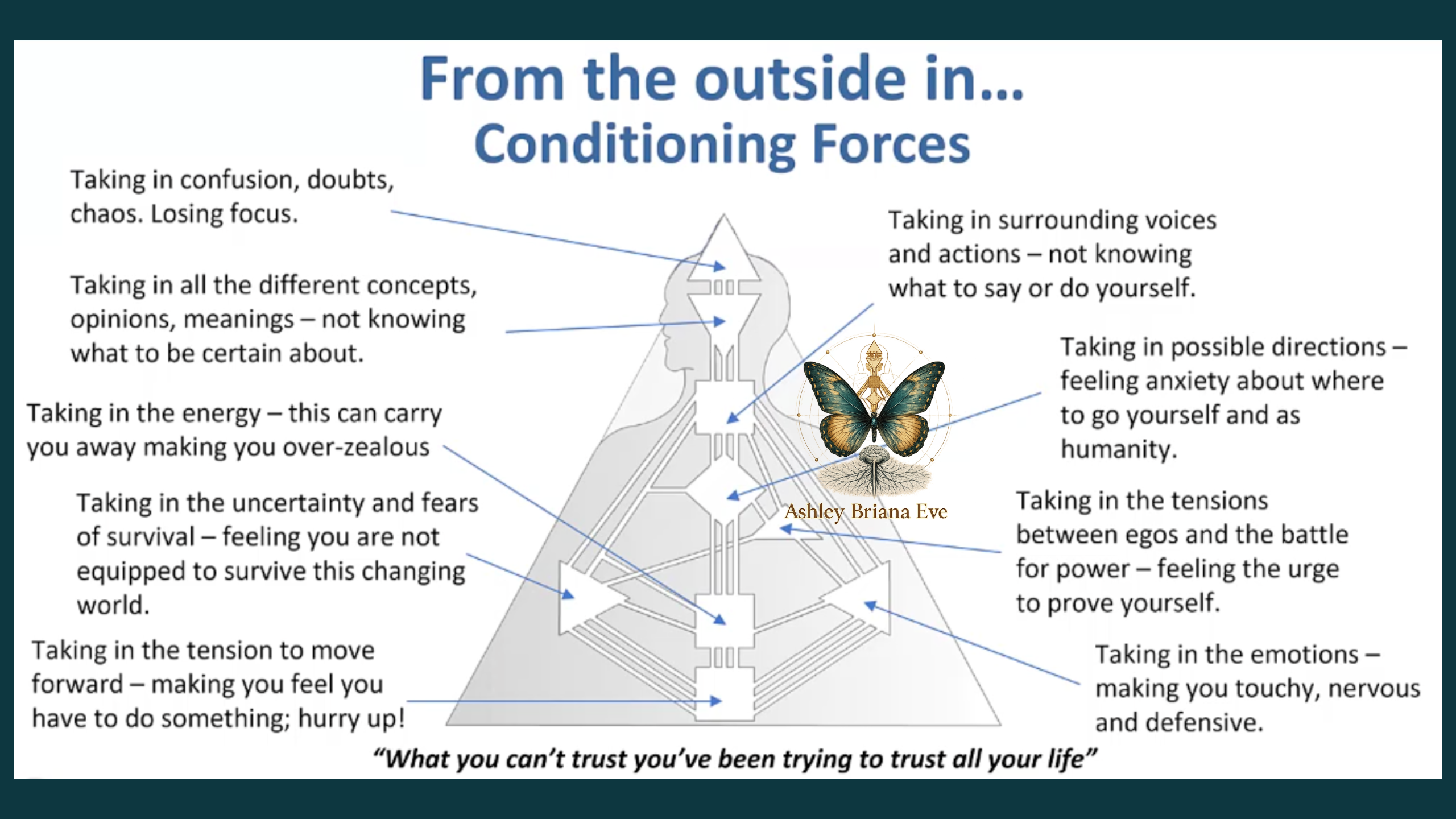
An open Ajna is designed to be mentally flexible. But its not-self can’t tolerate uncertainty, because not-knowing feels like not-enough. So it forces certainty. Being sure becomes proof you’re smart, capable, safe. You came here to live in the question — and instead you can’t breathe until you have the answer.
An open Sacral isn’t built for consistent life-force energy, and its not-self never knows when enough is enough. So you never let anything go (especially if you have an undefined splenic centre). You hold on too long, overcommit, stay years past the expiry, because stopping feels like failing. You’re not learning through experience. You’re gripping one thing and calling the exhaustion commitment.
An open Heart centre isn’t built to prove its worth through willpower — but its not-self does exactly that. It overpromises. It ties your value to your follow-through. So when something doesn’t work, it isn’t information — it’s a verdict. “I failed” collapses into “I am a failure.”
Three centres. Three behaviours. One engine: instead of surrendering to your design and letting life teach you, you prove, force, and grip so you can finally feel worthy. These behaviours are the branches; the identity they grew from is the trunk — and every bit of it grew from roots drawing on soil that wasn’t safe. The open centre is just the outfit the wound chose that morning.
Why it feels like you (and not like conditioning)
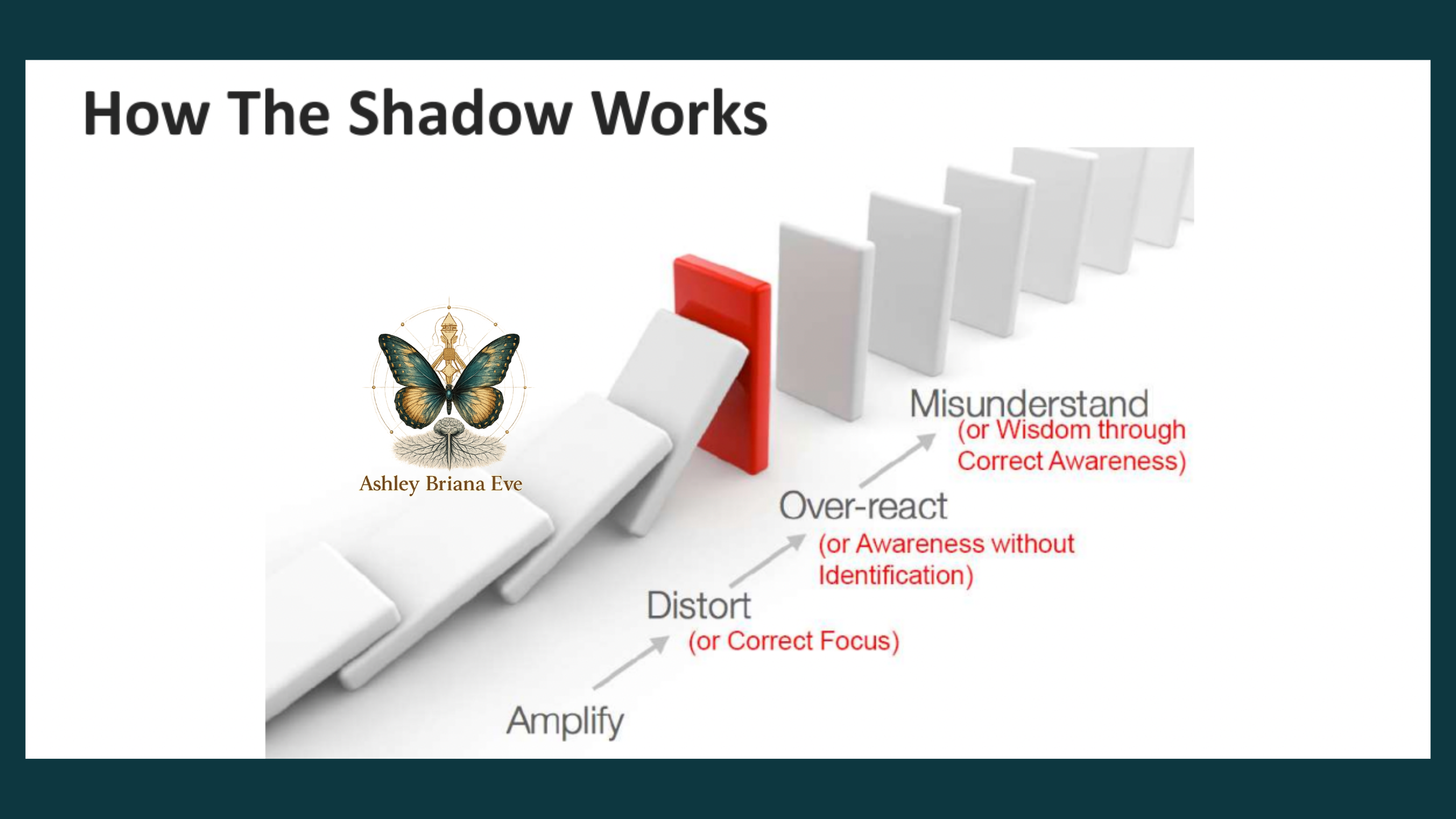
People hear all this and say: “But this is just who I am.” That exact sentence is the most important clue of all.
So much of our deepest conditioning is laid down in the earliest years — before we had the critical, analytical mind we have now. Small children absorb the emotional weather around them without filtering it: whether we’re safe, whether we’re enough, whether love must be earned. And the research is clear that not remembering something doesn’t protect you from it — early experience shapes adult patterns whether or not you can recall a single moment of it. So by adulthood, these patterns don’t feel like beliefs you picked up. They feel like you. There’s no memory of installing them. The roots grew around that early soil so long ago you mistook them for your own being.
The psychologist Carol Dweck spent decades studying this. In a fixed mindset, people believe intelligence and talent are fixed quantities — so failure becomes a statement about who they fundamentally are. Dweck found these people genuinely dread failure and avoid challenge, because struggling would mean they’re not as capable as they need to be seen as. In a growth mindset, people believe ability develops through effort, and they don’t fear failure nearly as much, because they’ve decoupled the error from their worth. Failure is simply where the learning lives.
So the high performer’s flinch is a fixed-mindset trunk grown from fear-conditioned roots and soil — sitting on top of a design built for growth-mindset experimentation. She was made to learn by trying. She built a life with no room for the very thing her soul came here to do.
Radical happiness was never the absence of struggle
Ra Uru Hu, who founded Human Design, was clear about something people desperately misunderstand. Knowing your design doesn’t mean you transcend struggle. It helps you meet the right struggle — the correct one, the one that’s actually yours. If you have an experiential design, your correct struggle is trial and error, and you were given the exact strengths inside your own definition to meet it. The struggle isn’t punishment. It’s the curriculum.
So what happens when the roots are running threat and you flinch away from your correct struggle? You don’t get to skip the struggle. You just trade your correct struggle for the wrong ones. Instead of the clean struggle of trying and learning, you get the grinding struggle of forcing certainty you don’t have, proving, gripping, controlling outcomes — because the outcome decides your worth. That’s the hamster wheel of healing: endless effort at the branches while the roots and soil go untended.
You don’t avoid the burn. You just burn in the wrong fire. One fire forges you. The other only consumes you.
This is what I mean when I say radical happiness is not the absence of struggle. It’s what grows when the roots are finally safe enough — and the soil around them tended well enough — to hold who you actually are. When you stop fighting the struggle that’s yours and stop drowning in the ones that aren’t. And here’s the reframe at the very root of all of it: the problem was never you. It was always the soil. Trial and error was never failure. It was always the design. The error was never proof you’re not enough — it was the path.
Next Steps
If any of this landed — if you felt the flinch while you were reading — I want to be careful with what I hand you now. Because the worst thing I could do is turn this into one more thing to perform. One more way to get it right.
So I’ll say it plainly: you don’t fix this from the branches. You can’t think your way out of a survival response, and you can’t discipline your way into feeling safe. The trying-harder is the old soil talking.
The work begins at the ground. It begins with giving your nervous system small, repeated evidence that falling short doesn’t cost you your safety or your belonging — that you can do a thing imperfectly and still be entirely, unconditionally enough. It begins with amending the soil around you: noticing which people and places leave your body a little safer, and deliberately growing more of those. It begins with prying apart two sentences that were always meant to be separate — I failed at this, and I am a failure — until the second one loses its grip. And only then, from steadier ground, does the behaviour begin to change on its own. Not forced. Grown.
None of that happens in an afternoon. The identities we’ve talked about — the forced certainty, the proving, the gripping — are old enough that we usually can’t even see them as separate from us. Untangling who you actually are from who you became to survive is a relationship, not a single insight. But it starts exactly here: with one moment of curiosity instead of one more moment of self-judgment.
Because the problem was never you. It was always the soil. And radical happiness was never the absence of struggle — it’s meeting the struggle that’s actually yours, in a body that’s finally safe enough to grow.
For paid Substack subscribers keep reading (or listening) because I have practical tools for lasting change included below. And always, if you are desiring deeper support please see https://www.ashleybrianaeve.com/ or email me at [email protected].
ashley
Founder: The Radical Happiness Movement & ADHD + HD
