
Why You Can Understand Human Design Authority and Still Not Live It
Jun 29, 2026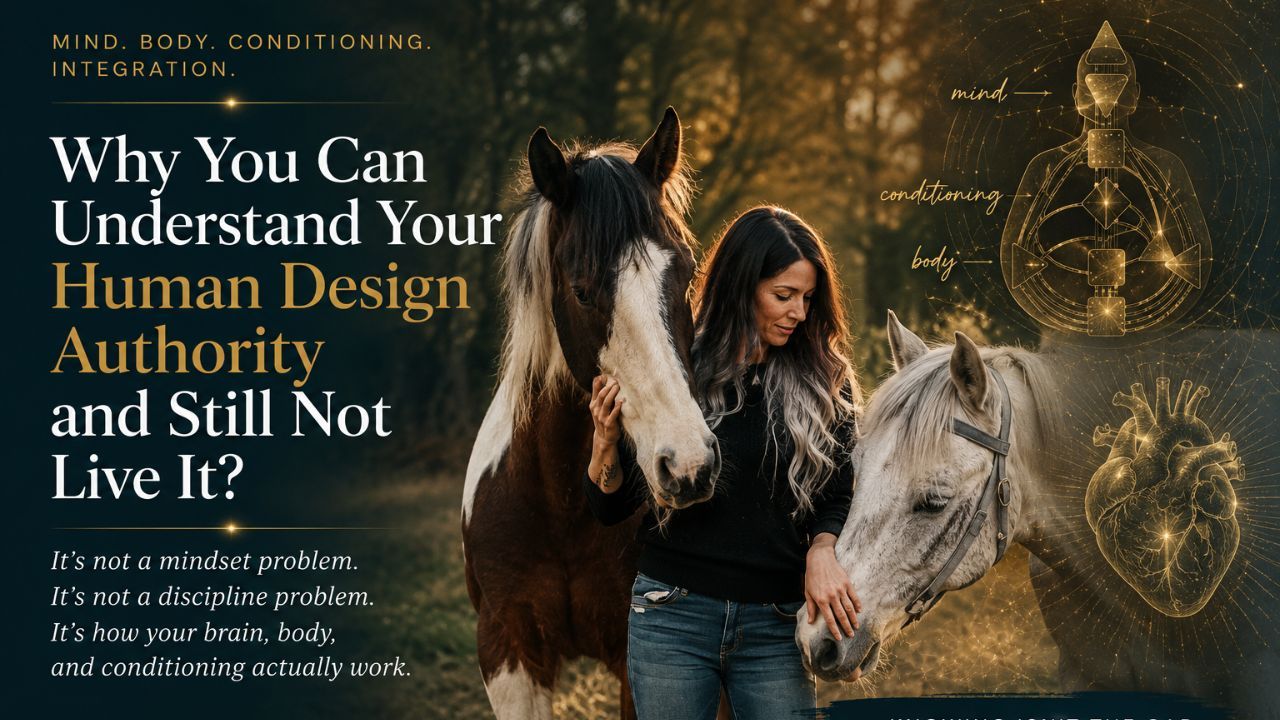
This article is for the high performer who desperately wants to live in alignment — and can’t figure out why they continue to meet resistance.
Not because you haven’t tried. Not because you don’t understand the frameworks. You’ve done the work. You’ve been in therapy, in coaching, in personal development of genuine depth. You understand your nervous system responses. You’ve studied your patterns. Many of you understand your Human Design, your inner authority, what intuition is supposed to feel like.
And you are still stuck. Still ending up in the same burnout cycles. Still overriding yourself. Still intellectually knowing what to do and being completely unable to actually do it.
That was me. Not that long ago.
I understood I was in burnout cycles. I knew I was repeating them. I knew, conceptually, that following my strategy and authority would make things easier. I understood the theory completely. And what I kept doing — what I couldn’t stop doing — was trying to intellectualize my way into a felt-sense experience. Trying to find the right framework, the right step-by-step process, the right timeline, the right logical sequence that would finally make my intuition accessible. I was trying to do a right-brain activity with my left brain. And it just didn’t work. Over and over and over again.
It wasn’t until I understood the actual mechanism that something shifted. And that’s what this article is about.
Here’s what I’ve seen across years of working with people — first in the mental health field, then as a coach. The people who come to me aren’t beginners. They are high performers who have genuinely done the work. They’ve been in therapy. They’ve read the books. Many of them understand their nervous system responses, their conditioning, their Human Design. They can articulate their patterns with a precision that would impress most practitioners.
And the thing that keeps coming up — almost word for word, across hundreds of conversations — is this:
“I understand my inner authority. I understand what intuition is supposed to feel like. I’ve studied it, I’ve worked with it, I get it. But I still can’t seem to actually embody it consistently. I still end up in the same burnout patterns. I still override myself. I know what I should do and I still can’t do it.”
For a long time, the personal development world has treated this as a motivation problem, a commitment problem, a ‘not doing the work’ problem.
I want to propose something different. I want to propose that it’s a mind body problem. And one that, once you understand the mechanism, actually makes complete sense.
The Brain Is Divided For a Reason
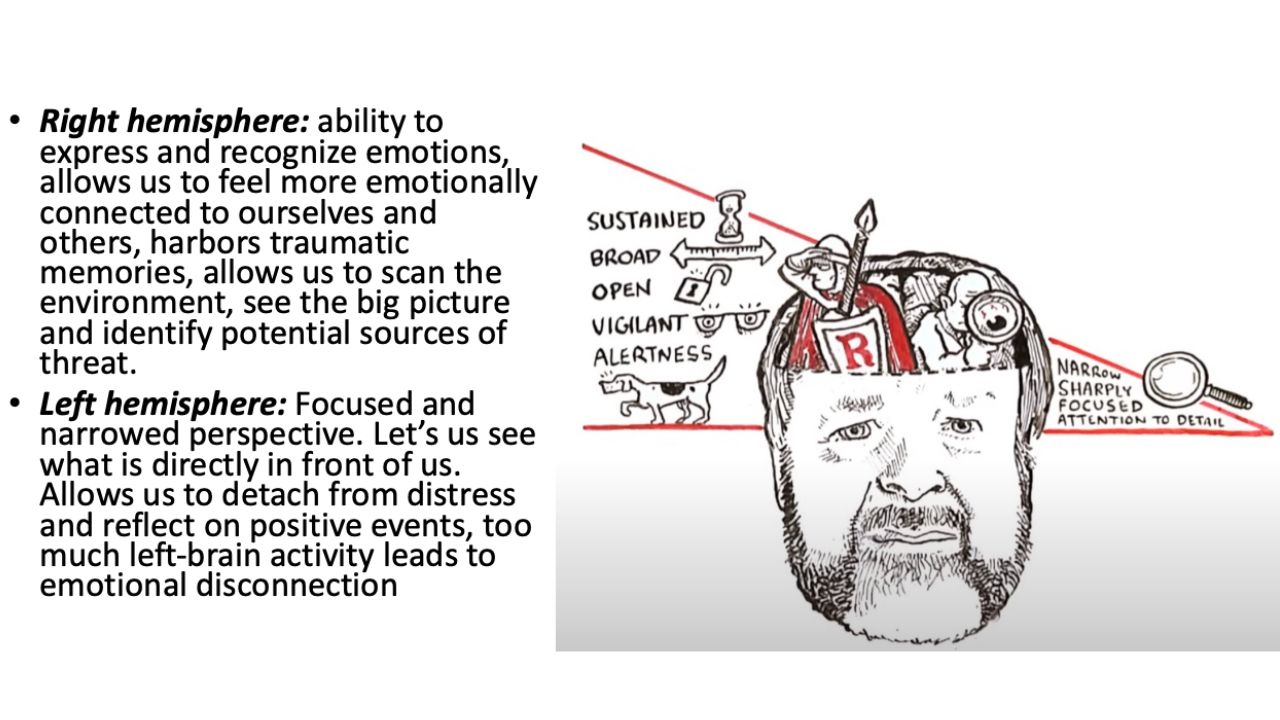
In 2009, a psychiatrist and neuroscientist named Iain McGilchrist published a book called The Master and His Emissary. It was the result of twenty years of research into one question: why is the brain divided into two hemispheres?
His answer is not the pop psychology version. It’s not ‘left brain is logical, right brain is creative.’ Both hemispheres are involved in almost everything. What he found is that the two sides of the brain attend to the world in completely different ways.
The right hemisphere takes in the whole picture. Context. Relationship. The living, breathing reality of a situation. It’s the part of the brain most directly connected to the body — to what the gut is registering, what the heart is feeling, what the somatic system already knows before the thinking mind has caught up. McGilchrist calls it the Master. It’s designed to lead.
The left hemisphere does something different. It takes what the right hemisphere has already grasped and breaks it down. Sequences it, categorizes it, puts it into language, makes it executable. It’s brilliant at what it does. McGilchrist calls it the Emissary — a brilliant servant, but a very poor master.
The problem he documents — across history, culture, and individual lives — is that we have built a world that runs almost entirely on Emissary thinking. Analytical. Measurable. Linear. Controlled. The right hemisphere’s intelligence — the contextual, the somatic, the whole-picture — has been progressively sidelined.
“The emissary became contemptuous of his master. The domain became a tyranny.” — Iain McGilchrist
When I read that, I thought immediately of every high performer I’ve worked with who couldn’t access their own body’s intelligence — not because they weren’t trying, but because the part of the brain built to receive it had been pushed aside by the part that analyses everything.
Forget Three Body Problem, We Have a Three Brain “Problem”
Here’s something that doesn’t get talked about nearly enough: the brain in your head is not the only intelligence system in your body.
You have three.
The gut has its own nervous system — roughly 500 million neurons, producing about 95 percent of your body’s serotonin, operating completely independently of your cranial brain. When people talk about gut instinct, they’re not speaking poetically. They’re describing a literal neurological event: hundreds of millions of neurons generating a signal before your conscious mind has had a single thought about the situation.
The heart has its own neural network too — about 40,000 neurons, first documented by neurocardiologist Dr. J. Andrew Armour in 1991. What HeartMath Institute’s thirty-plus years of research has found consistently surprises people: the heart sends more signals up to the brain than the brain sends down to the heart. The relationship isn’t top-down. The heart is constantly informing the head, carrying emotional intelligence and relational knowing upward.
I saw this firsthand. When I worked as a counsellor in a neuroplasticity program run in conjunction with the Canadian Mental Health Association, we used equine-assisted therapy built on HeartMath Institute principles. Research shows that when humans intentionally achieve a calm, coherent heart state, their heart rhythms can synchronize with those of nearby horses — and that synchronization measurably lowers human stress levels and blood pressure. A horse cannot be reasoned with. It cannot be told a story about how calm you are. It responds only to the actual electromagnetic field of your heart. I watched this happen repeatedly. The horse was always more honest about the state of a person’s cardiac brain than the person was.
And the right hemisphere of the cranial brain is the part designed to receive what the gut and the heart are sending. It’s broad, embodied, contextually attuned. It’s the bridge.
The vagus nerve — the longest cranial nerve in the body, running from the brainstem all the way down through the heart and digestive tract — is the information highway that carries those signals upward. And here’s the part that matters: approximately 80 percent of vagal communication travels from the body up to the brain. Not the other way around. The body is constantly sending intelligence upward. The question is whether the brain is positioned to receive it.
The gut speaks. The heart speaks. The vagus nerve carries those signals upward. The right hemisphere is designed to receive them. That is the natural sequence. That is what inner authority actually is — not a concept, a neurological process.
The Bridge Is Closed
When left-hemisphere dominance takes over — and for most high performers in our culture, it has — this sequence breaks.
The gut is still generating signals. The heart is still sending information upward. The vagus nerve is still carrying it toward the brain.
But the right hemisphere — the bridge, the receiver — is not leading. The left hemisphere has stepped in. And the left hemisphere cannot receive what the right was built for. It can only analyze what has already arrived.
This is why you can understand your inner authority completely and still not feel it. The understanding is happening in the left hemisphere. But inner authority is a right-hemisphere experience. You’re using the wrong tool. Not because you’re doing it wrong — because the tool you’ve been trained to trust cannot do this particular job.
People are essentially trying to have a felt sense of safety and a felt sense of inner authority while simultaneously trying to logically process it. And those are two totally different hemispheres with two totally different jobs. It’s not going to work. Not because the person is failing — because the nervous system isn’t built for that.
Knowing about your intuition and experiencing your intuition are not the same thing. The gap between them is neurological. No amount of knowing closes a neurological gap.
How the Bridge Gets Closed
This doesn’t happen by accident. There are three main pathways, and most people have some version of all three.
The first is cultural. From school onward, we are rewarded for left-hemisphere thinking: analytical performance, linear reasoning, the ability to articulate and defend our conclusions explicitly. The right hemisphere’s way of knowing — somatic, contextual, whole-picture — is almost never taught, rarely valued, and often treated as unreliable. Most high performers have spent decades developing extraordinary left-hemisphere capability, often at the direct expense of right-hemisphere access. This is not a personal failure. It’s the entirely predictable result of a system that trained the Emissary and ignored the Master.
The second is adaptive. For people whose nervous system found the world overwhelming — and this is far more common than we acknowledge — left-hemisphere analytical thinking became a survival strategy. Thinking your way through things worked. Predicting, preparing, controlling variables. The left hemisphere took over navigation because it felt safer than trusting the body. That’s smart adaptation. It’s also, over time, a way of becoming deeply disconnected from the intelligence system that was trying to guide you all along.
The third is trauma. Dr. Bessel van der Kolk’s research shows what happens in the brain during traumatic activation: Broca’s area — the left hemisphere’s language centre — goes offline. The right hemisphere activates. Trauma lives in the body, in sensation and image, in right-hemisphere territory. The left hemisphere’s capacity to detach from distress becomes, in chronic trauma, a full disconnection from the body’s signals. The body becomes a place of threat rather than safety. Its intelligence becomes something to manage rather than trust. The bridge isn’t just closed. It’s actively avoided.
Where Human Design Comes In
I want to be honest about how I understand Human Design, because I think it’s often misused in a way that actually reinforces the problem rather than solving it.
When people approach Human Design analytically — mapping their chart, categorizing their type, trying to logically determine what their authority should feel like — they’re using the left hemisphere to try to access a right-hemisphere experience. They’re studying the map rather than learning to read the territory. And the territory is the body.
Used well, Human Design is something different. It’s a practical starting point for getting in touch with what your intuition specifically feels like for you, as an individual. Not everyone’s sacral response feels the same. Not everyone’s emotional wave moves at the same pace. Not everyone’s splenic hit arrives through the same channel. Human Design gives people a personalized framework for beginning to notice what their body’s intelligence actually feels like, rather than trying to access a generic version of intuition.
I don’t think Human Design should become a crutch, or a box you put yourself in, or a permanent explanation for every pattern. I think it’s a genuinely useful tool for beginning to close the gap between knowing what intuition is supposed to be and actually experiencing what it feels like for you. It’s a doorway into right-hemisphere experience, not a gilded cage.
But — and this is the part I don’t hear discussed enough — it only works if the bridge is functional enough to receive the signals it’s pointing you toward. Ra Uru Hu had made a joke about how “the same Generators are coming to me 15 years later with the same problems”. It’s my belief this is why.
If the nervous system is chronically dysregulated, if left-hemisphere dominance is well-established, if the connection between body and brain is compromised, Human Design study alone will not close the gap. You can understand your authority completely and still not feel it. Because the bridge is closed.
Branch Work Won’t Fix a Root Problem
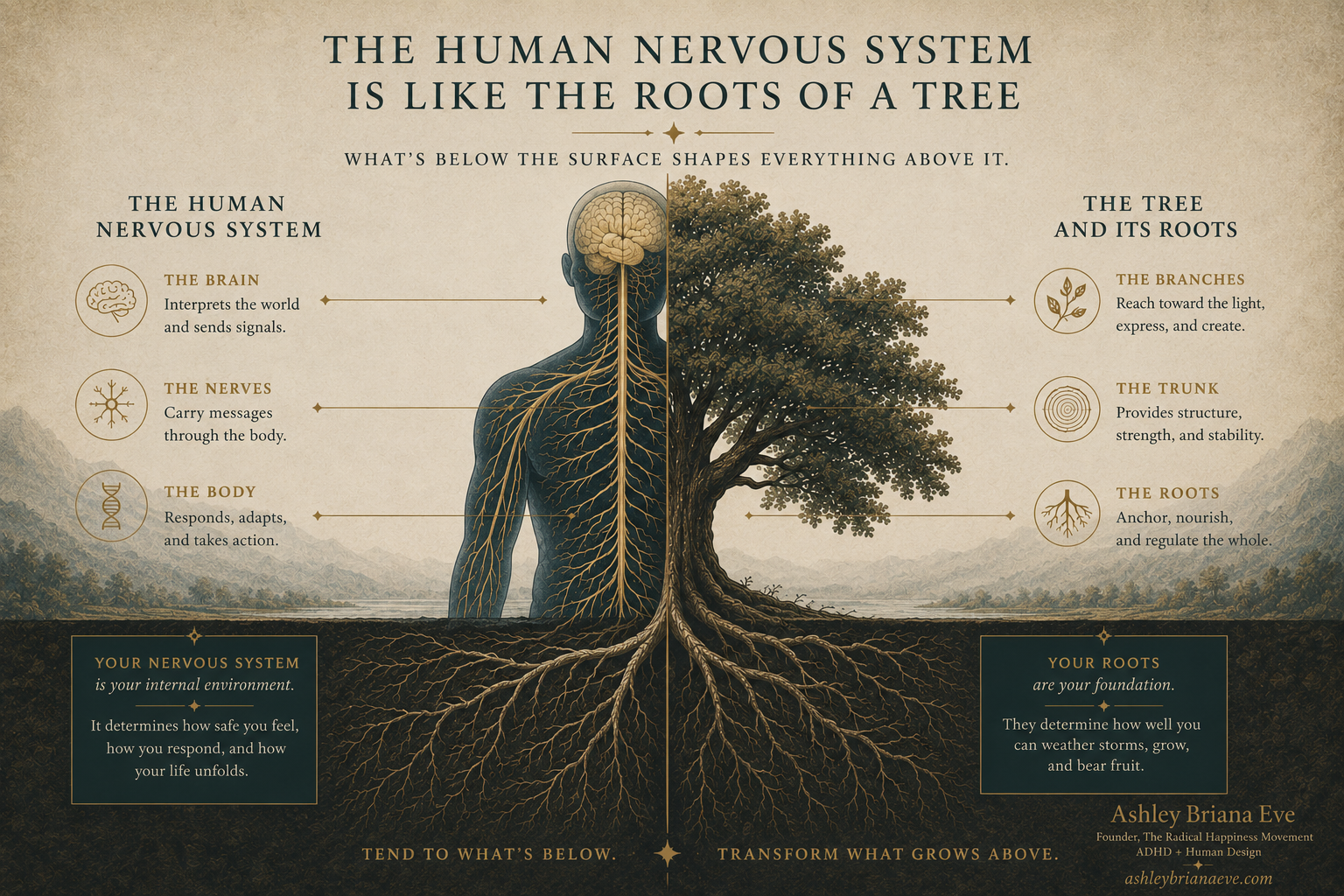
This is where I want to bring in a framework that sits at the centre of everything I do: The Root System™.
Think about a tree that’s producing damaged fruit. The branches are rotting at the edges. The conventional response is to prune — cut back what isn’t working, manage the output, try to get better results through the part you can see.
But what if the problem isn’t the branches? What if the soil is toxic, or the roots are starved? You can prune forever. The tree will keep producing the same damaged fruit — because nothing has changed at the layer that actually matters.
Most approaches to intuition and inner authority are branch work. They address the behaviour — the output, the decision-making, the ‘how do I follow my gut’ — without addressing the nervous system underneath it. The roots.
And the roots, in this framework, are the nervous system. The communication between body and brain. The vagal tone that determines whether the information highway is open or closed. The right hemisphere’s capacity to lead rather than be subordinated to the left.
When the roots are dysregulated — when chronic stress, trauma, or years of left-hemisphere dominance have compromised the body-brain connection — branch-level work doesn’t touch the actual problem. You can read every book on intuition ever written. You can understand every detail of your Human Design chart. You can intellectually grasp exactly what inner authority is supposed to feel like.
And you will still be trying to access a felt sense while running entirely from the hemisphere that cannot produce one.
You cannot fix a root problem from the branch layer. And you cannot access body intelligence from inside left-hemisphere dominance. These aren’t motivational failures. They’re structural ones. Which means they require structural solutions.
What Actually Helps
The research is consistent here: what restores the bridge is embodied practice. Not because it’s spiritually superior to cognitive work — but because it works at the layer that cognitive work cannot reach.
Van der Kolk’s research found that the most effective treatments for trauma-based disconnection are body-based: yoga, EMDR, somatic experiencing, neurofeedback. Bilateral stimulation, which I use with clients frequently and is a core of Polyvagal Yoga, appears to restore hemispheric communication by moving the brain’s processing across the midline — from left hemisphere to right — integrating what was fragmented.
Polyvagal theory, developed by Dr. Stephen Porges, gives us specific, practical ways to restore vagal tone and re-open the information highway: slow rhythmic breathing, humming, safe social connection, gentle movement. These aren’t suggestions drawn from a wellness Instagram. They are documented vagal nerve interventions that physically improve the body-brain communication pathway.
And Dr. Arielle Schwartz, a mentor of mine and whose work in applied polyvagal theory I deeply respect, teaches something I come back to constantly: in a regulated nervous system, the right brain leads the left.
Not through willpower. Not through more study or more effort. Through regulation. Through safety. The right hemisphere doesn’t need to be trained. It needs to be restored to the conditions where it’s safe for it to lead again.
When that happens — when the nervous system is regulated, when the body feels safe, when the bridge is open — inner authority stops being a concept you understand and becomes something you feel. The sacral response becomes unmistakable. The emotional wave becomes something you move through rather than analyze. The gut’s intelligence arrives with clarity rather than being overridden before it’s even registered.
The intelligence was never missing. The body was always speaking. The bridge just needed to be restored.
To begin your work with this approach I recommend a Human Design foundation session, linked HERE. Having the map is the first step to lasting change. If you desire to go deeper it is after a foundation session that long term support is possible, where we work from the bottom up for true change from the inside out.
ashley
A follow-up to this piece is coming specifically for those navigating this through the lens of ADHD — where the correlation between dopamine dysregulation, left-hemisphere dominance, and the chronic inability to access inner authority runs even deeper. If that’s you, it’s on its way.
Ashley Briana Eve is the founder of the Radical Happiness Movement and the creator of the ADHD + Human Design methodology and The Body Intelligence Map™. Her work sits at the intersection of neuroscience, Human Design, positive psychology, and somatic intelligence. She works with high performers, organizations, and teams navigating burnout, identity, and the gap between understanding themselves and actually living from that understanding.
Find her at ashleybrianaeve.com | 🎙️The Radical Happiness Podcast & ADHD + HD Podcast
Author


