Stop Asking What Your Brand Should Say. Ask This Instead.
Aug 30, 2026
There’s one idea I’ve come back to again and again throughout my years in branding: your brand has exactly one job, and that job is to create an emotional connection by occupying a distinct psychological role in the marketplace. Not to be everything. Not to appeal to everyone. Not to communicate every dimension of who you are. Its job is to mean something specific to the people you actually want to reach — because people don’t form relationships with brands based on a list of attributes on a slide. They connect with what a brand represents, how it makes them feel, and the role it plays in their world. If you haven’t consciously chosen that role, you’re leaving one of the most important parts of your brand to chance.

I’ve been sitting with this a lot today. I just wrapped up a video about something I think is fundamentally broken in how we talk about branding: we spend way too much time trying to define what a brand is and nowhere near enough time deciding what role it plays in someone’s world. When what the brand is really is an extension of the role it plays.
Then I sat down to watch Lioness, and — predictably — my brain kept working the whole time. (Side note: Taylor Sheridan is ridiculously good at world-building. The man understands how to construct a world people actually want to step inside. I have an old video on this buried in my Google Drive somewhere; if I can dig it up, I’ll get it onto YouTube.)
Your Brand Doesn’t Need to Be Everything
Think about how you actually move through your own life. You’re not every version of yourself with every person you know. You’re not the same person with your best friend that you are in a business meeting, and you’re not the same person at a rock show that you are at a parent-teacher conference. Your Disney-loving friend group may not even know the version of you that’s out at rallies advocating for social change. None of that makes you fake — different contexts simply call different parts of you forward. Your brand works exactly the same way. It doesn’t need to represent every single thing about you; it needs to play one specific role, consistently.

This is where I think brand archetypes get far more interesting than the personality-quiz version most people encounter. Because the real question isn’t “which archetype am I?” That’s the wrong frame entirely.
The better, more useful question is: what psychological role does my brand play in the marketplace? That’s a completely different question, and it carries much bigger implications for everything you build.
People Aren’t Looking for More Information
Your audience isn’t short on information — we’re drowning in it. We’ve fully shifted into the attention economy, where the scarce resource isn’t content, it’s feeling. People are looking for something that makes them feel seen, challenged, safe, inspired, powerful, free, curious, or capable.
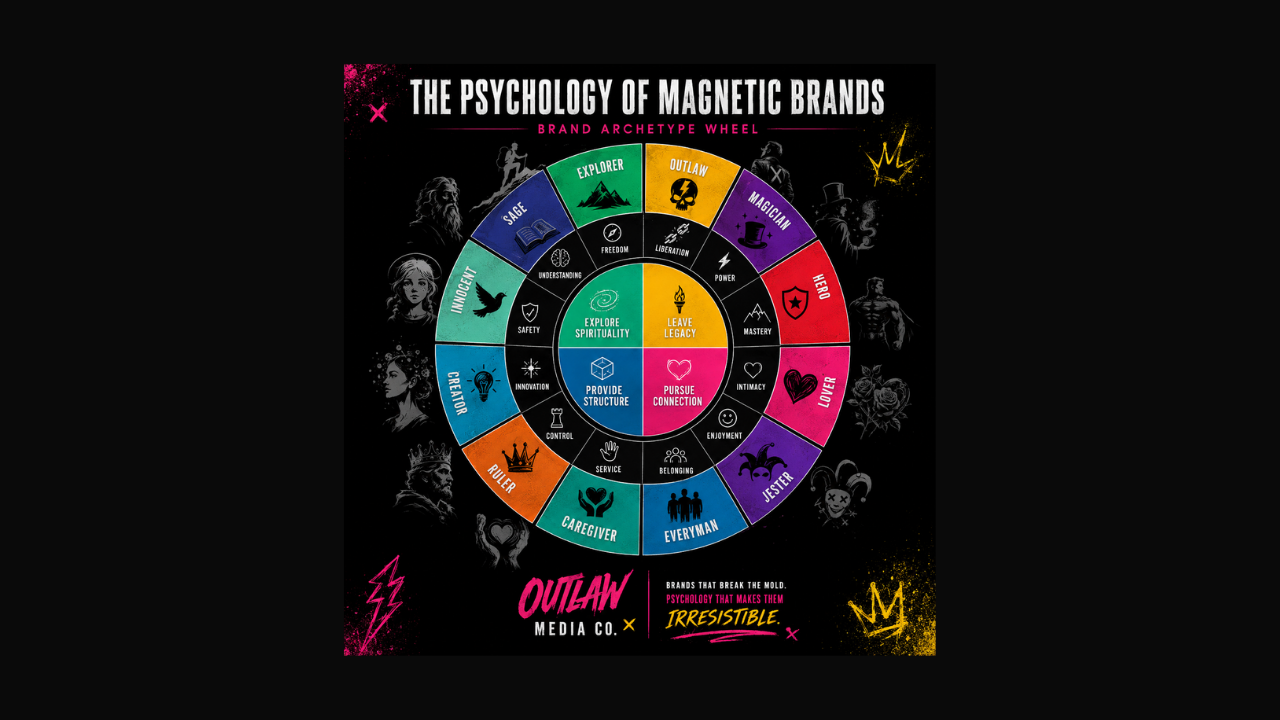
Different brands create different emotional experiences precisely because they occupy different psychological roles: the Rebel gives you permission to break the rules, the Explorer opens a door to something beyond the ordinary, the Caregiver creates safety and belonging, the Creator makes you believe something new can exist, and the Ruler represents mastery, control, status, or authority.
None of these roles are better than the others — they’re simply different jobs. And that’s the entire point: your brand has a job. That job isn’t to make everyone like it. It’s to make the right people understand why it exists.
“Just Be Yourself” Is Incomplete Advice
This is why “just be yourself” has always struck me as incomplete branding advice. Yes, be yourself — but which version of yourself is actually relevant to the role you’re building?
Your personal brand was never meant to be a documentary of your entire existence. It’s a relationship, and relationships have context. You don’t walk into every relationship in your life and dump your full psychological operating system onto the table; you show up in a particular way because that relationship has a particular purpose.
Brands function the same way. When you try to make your brand communicate everything you care about, everything you’ve experienced, everything you’re good at, and everything you might possibly want to sell someday, you will struggle to stand out in busy feeds — and this makes your attempts to be seen feel like a hamster wheel from hell.
(Important nuance: You MUST be willing to test and to do so publicly. If you do not test, and fail horribly over and over, you will not be successful. What I am speaking to is not testing, it’s an intentional attempt at bringing all of your into your brand at all times.)
The brands we actually remember give us something specific to hold onto. Think about the brands you can recognize almost instantly:
-
Taylor Swift
-
Disney
-
Nike
-
Patagonia
-
Harley Davidson
-
Apple
You probably couldn’t recite their full brand strategy off the top of your head, and you don’t need to — you know what they feel like, what they represent, the role they play in your life. That’s psychological positioning at work. Which is why I think the most important branding question was never “what should my brand say?” It’s this: who — or what — am I becoming in the life of my customer?
That single question changes everything downstream of it. It changes what you create, what you say yes to, what you say no to, who you attract, what your content sounds like, and what your products eventually become. Ultimately, it determines whether people remember you at all.
The Question Worth Sitting With
So if you’re building a personal brand right now, here’s what I’d actually sit with: what role do you want your brand to play in someone’s life? Not “what can I teach?” Not “what am I an expert in?” Not even “what do I want to be known for?”
Do not worry about that just yet.
The real question is what psychological job your brand does for the people who choose to have a relationship with it. Because once you know that, you stop trying to be everything — and you finally get to become something. And something memorable will always beat everything forgettable.
Want to go deeper? I unpacked this entire idea — brand archetypes, psychological connection, and why choosing your role in the marketplace matters — in my latest YouTube video.
Watch it HERE.
And now, if you’ll excuse me, I’m going to stop thinking about branding for approximately 47 minutes and watch Lioness! This season is wilddd!
Ashley
Founder: Outlaw Media Co.
I build media companies, creative IP, and education for people who want to make something that didn’t exist before.
Host of Shadows & Static the Podcast (Watch HERE)
