
Why Human Design Isn’t Working for You (And the Somatic Truth About the Not-Self)
Mar 26, 2026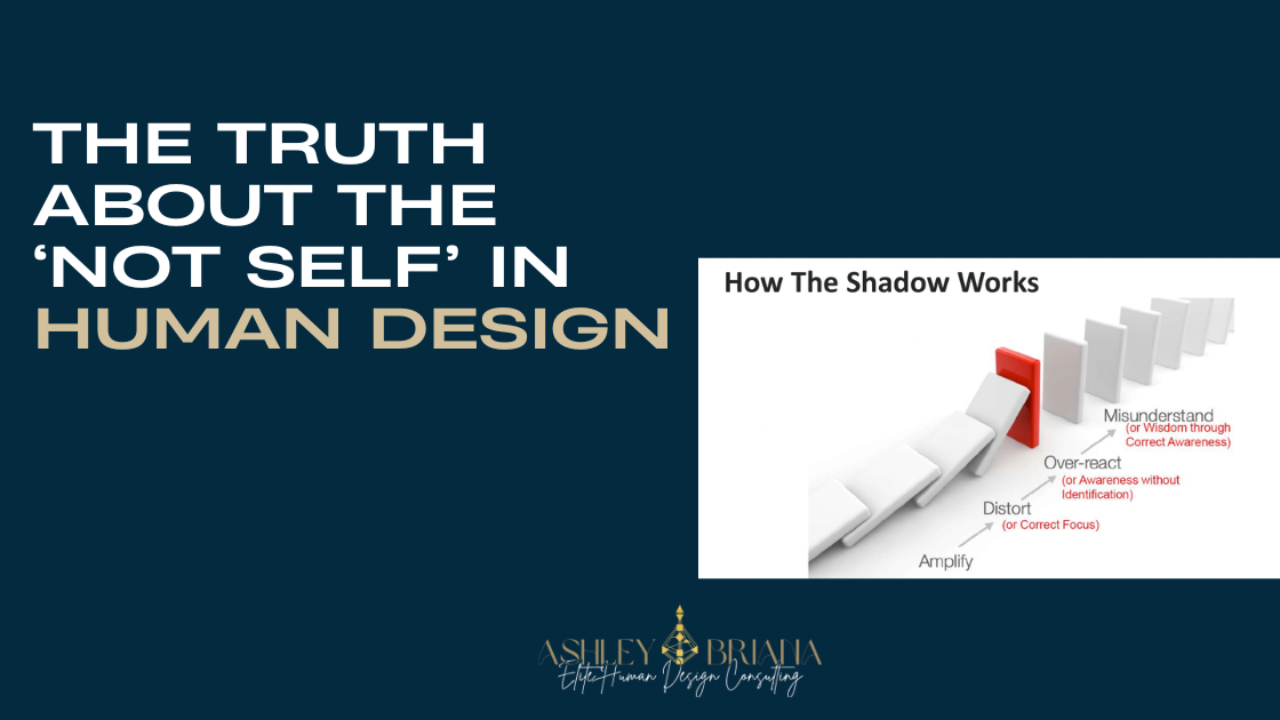
Have you been studying Human Design—learning your type, your authority, your open centers—and yet nothing seems to shift long term? You understand yourself more, you can name your patterns, you can even catch yourself in them in real time, and still you find yourself back in the same cycles: the same emotional spirals, the same overthinking, the same dynamics playing out in your relationships. At some point, the question starts to creep in—if I’m so aware, why does this keep happening? And this is the moment most people either double down on consuming more information or quietly begin to disconnect from the work altogether, because it feels like it should be working, but it isn’t, and no one is really explaining why.
Everyone wants to talk about the not-self as if it’s a mindset problem—something you can observe, reframe, and eventually outgrow through awareness. It’s positioned as a pattern of thinking, a distortion in perception, or a loop that can be interrupted with enough consciousness.
But the truth is, it is somatic.
And until that is properly understood, people will continue to circle the same patterns while believing they’ve already done the work to move beyond them. Awareness becomes a ceiling instead of a breakthrough, because it is being applied to the wrong layer of the problem.
The not-self is not simply a mental misinterpretation. It is the result of an incomplete physiological process.
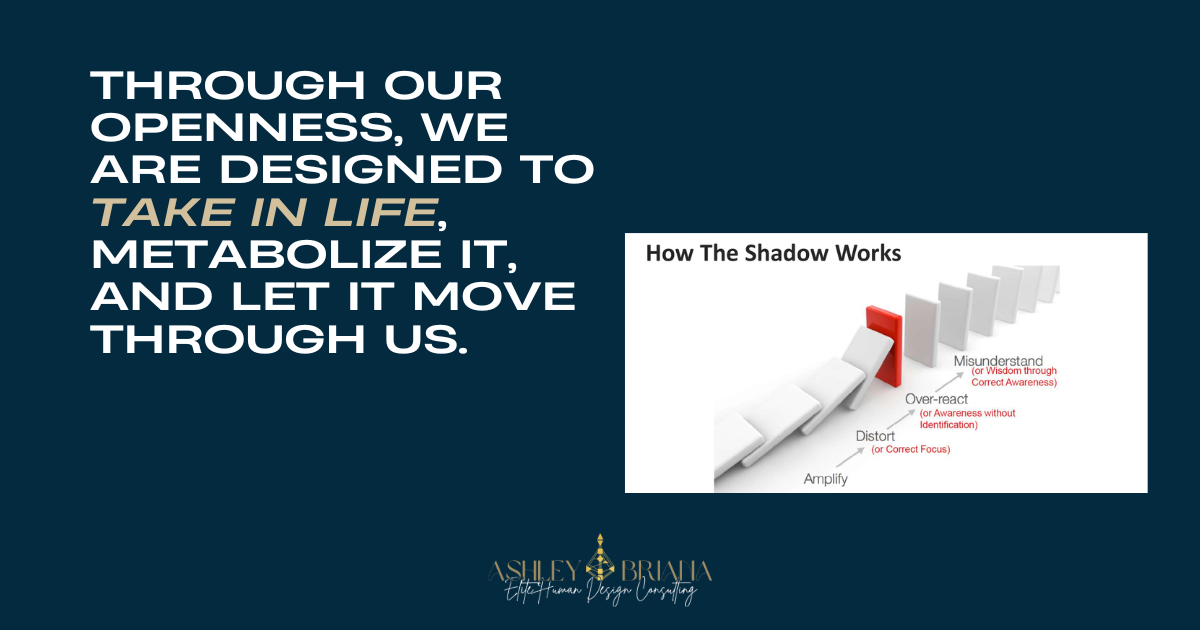
Human Design points to openness as the place where we experience and engage with life. Through our undefined centres, we take in energy, amplify it, and—when the system is functioning as intended—metabolize it and allow it to move through us. This process is not conceptual. It is biological. It relies on the nervous system’s capacity to tolerate intensity, process stimulation, and return to baseline.
When that capacity is compromised, the process breaks.
The energy does not move through. It remains in the system.

And the moment something remains in the body without resolution, the mind is recruited to interpret it.
This is the point most people misunderstand. They assume the story is the origin of the problem, when in reality the story is a response to an unresolved sensation. The body is holding something it cannot process, and the mind steps in to create meaning as a way to regain a sense of control.
Over time, those meanings solidify.
What begins as a moment of amplification becomes a pattern of identification. Sensations become statements. Experiences become identities. And eventually, people start to describe themselves through the lens of what their system has never fully processed.
This is where the not-self takes hold—not as a flaw in thinking, but as a misidentification with unprocessed experience.
Consider the undefined Solar Plexus. The design is not the issue. The capacity to feel and amplify emotional energy is not a weakness; it is a form of intelligence. The distortion occurs when the nervous system cannot tolerate the intensity of what is being amplified.
In a regulated system, amplified emotion is information. It moves through, it informs, and it leaves.
In a dysregulated system, amplified emotion feels personal.
It is absorbed, interpreted, and often internalized as evidence. Someone else’s frustration becomes “they are upset with me.” A shift in tone becomes “I did something wrong.” The body reacts first, and the mind follows with a narrative that attempts to explain the discomfort.
From there, behaviour becomes predictable. People-pleasing emerges as an attempt to neutralize the perceived threat. Hyper-vigilance develops as a strategy to anticipate emotional shifts before they escalate. The individual is no longer relating to reality—they are relating to the story created to manage what their body could not process.
And yet, the focus remains on changing the thought.
This is where most approaches fail.
You cannot cognitively override a nervous system that does not feel safe. You cannot “reframe” your way out of a physiological state that has not resolved. As long as the body is holding the charge, the mind will continue to generate stories to justify it. The not-self persists, not because you lack awareness, but because the process that would dissolve it has never completed.
This is why the conversation around Human Design needs to evolve.
Openness is not inherently wisdom. It becomes wisdom when the system has the capacity to experience without attaching. When amplification can occur without identification. When sensation can move without being turned into a narrative about the self.
That requires regulation.
Not as a trend, not as a soft add-on to personal development, but as the foundation that determines whether your design functions as intelligence or distortion.
Without it, openness becomes a trap. With it, openness becomes one of the most refined forms of perception available.
And this is where everything shifts.
Because the goal is not to eliminate the not-self through mental effort. The goal is to restore the body’s ability to complete the process it was designed for. To take in, to feel, to metabolize, and to release—without needing to turn every internal experience into an identity.
When that happens, the stories lose their grip. Not because you fought them, but because they are no longer required.
The body no longer needs the mind to explain what it can now safely process.
And in that space, something much more accurate emerges.
Clarity. Stability. And a sense of self that is no longer built on what was never yours to carry in the first place.
If you’re ready to see how this shows up in your body—and where your system gets pulled into cycles of stress and overwhelm—I offer Human Design Foundation Calls.
This is where we map your design through the lens of your nervous system, so you can see, clearly, what’s happening in real time and what it actually takes to shift it.
Learn more here: https://www.ashleybrianaeve.com/human-design-private-session
ashley
