The Brain-Body Biofeedback Loop: Why Stress Gets Stuck in the Body
Jul 07, 2026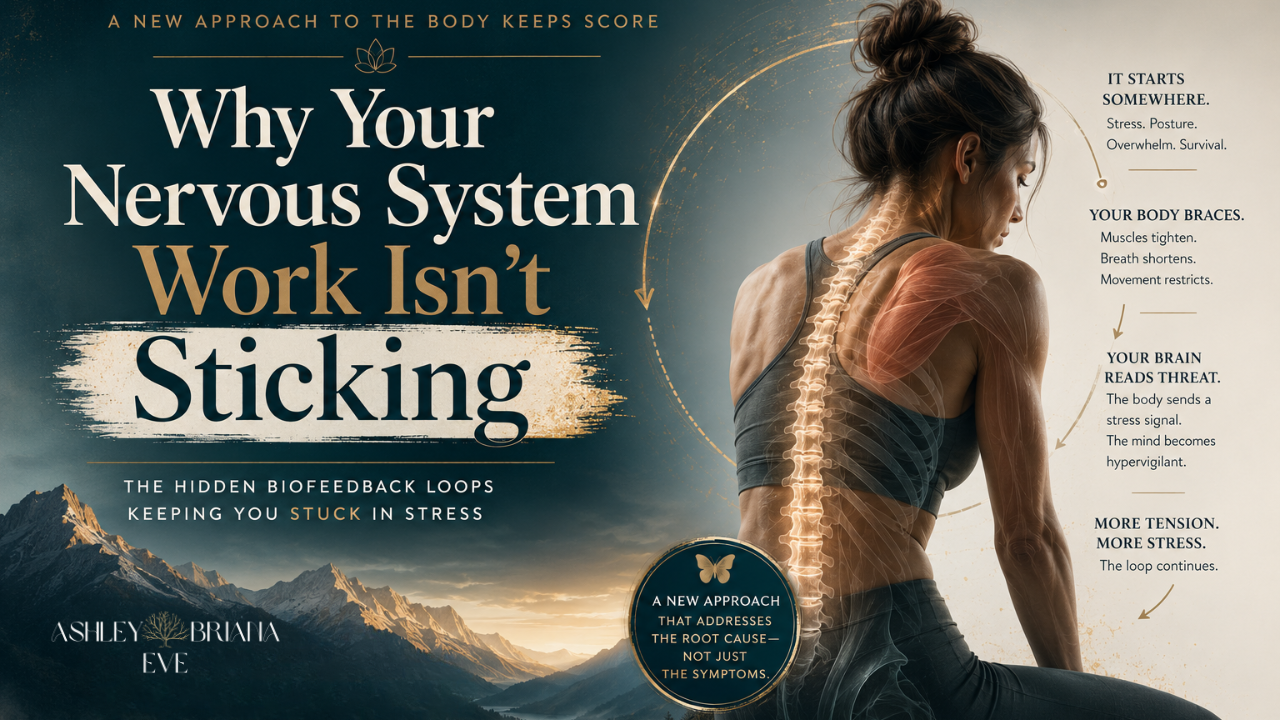
Have you felt as though you are doing everything right and yet you aren’t making sustainable change in your nervous system? We’re often told that stress is a psychological problem. I think that’s only part of the story.
Earlier in my career, I worked as a mental health counsellor while also running a successful personal training studio (Yes, I’ve lived a lot of lives in one!). A serious injury forced the closure of my studio — I herniated my L5-S1, tore my bicep tendon and my labrum, at a time when I was strong enough to be training for the CrossFit Games.
Despite shifting out of the personal training field I never lost the obsession that came out of that period: how the body keeps score, and how alignment begins in the body itself. Since then, work like Bessel van der Kolk’s The Body Keeps the Score and Stephen Porges’ polyvagal theory has brought this idea into the mainstream.
What I want to offer in this article is a reframe. Because I think we have inherited a model of stress that is quietly incomplete — and that incompleteness is the reason so many capable, committed, self-aware people do all the right things and still can’t get free of the anxiety, the tension, the sense of running on a nervous system that never fully settles.
The inherited model says stress is something that happens in the mind, and therefore something we address at the level of the mind. Think differently. Reframe the thought. Manage the response. And there is real value in that work — I trained in it, I practised it, I still use it. But it treats the body as the thing that receives the mind’s instructions, rather than as an intelligence in its own right that is constantly informing, shaping, and sometimes overriding what the mind is able to do.
That hierarchy — mind on top, body below, taking orders — is exactly backwards from how the physiology actually works.
Everything Right, and Still Stuck
Everything that follows rests on one principle: High performers don’t just experience stress. They become trapped in biofeedback loops. It may begin with a major life stressor. Or it may begin with something as ordinary as the way you sit at your desk for eight hours a day. Either way, the result is the same.
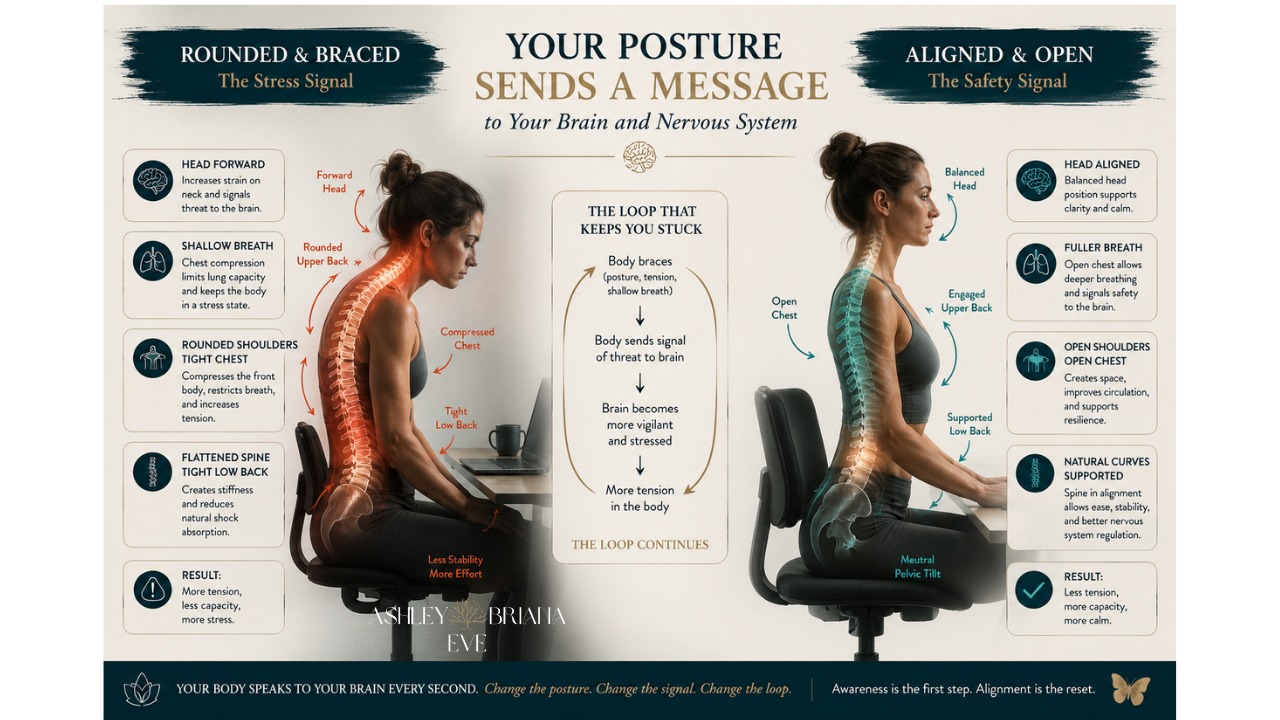
Your body gradually adopts a protective, braced posture. Tight muscles, compressed breathing, rounded shoulders, a nervous system preparing for a threat that may no longer exist. The brain doesn’t experience this as “just posture.” It experiences it as information.
Your body continually signals, Something isn’t safe. The brain responds by becoming more vigilant. More anxious. More prepared. That heightened state increases muscular tension even further. The body tells the brain there’s danger. The brain tells the body to brace. And the loop reinforces itself until stress is no longer something you’re experiencing. It becomes something your entire mind-body system is rehearsing.
When Best Intentions Reinforce the Loop
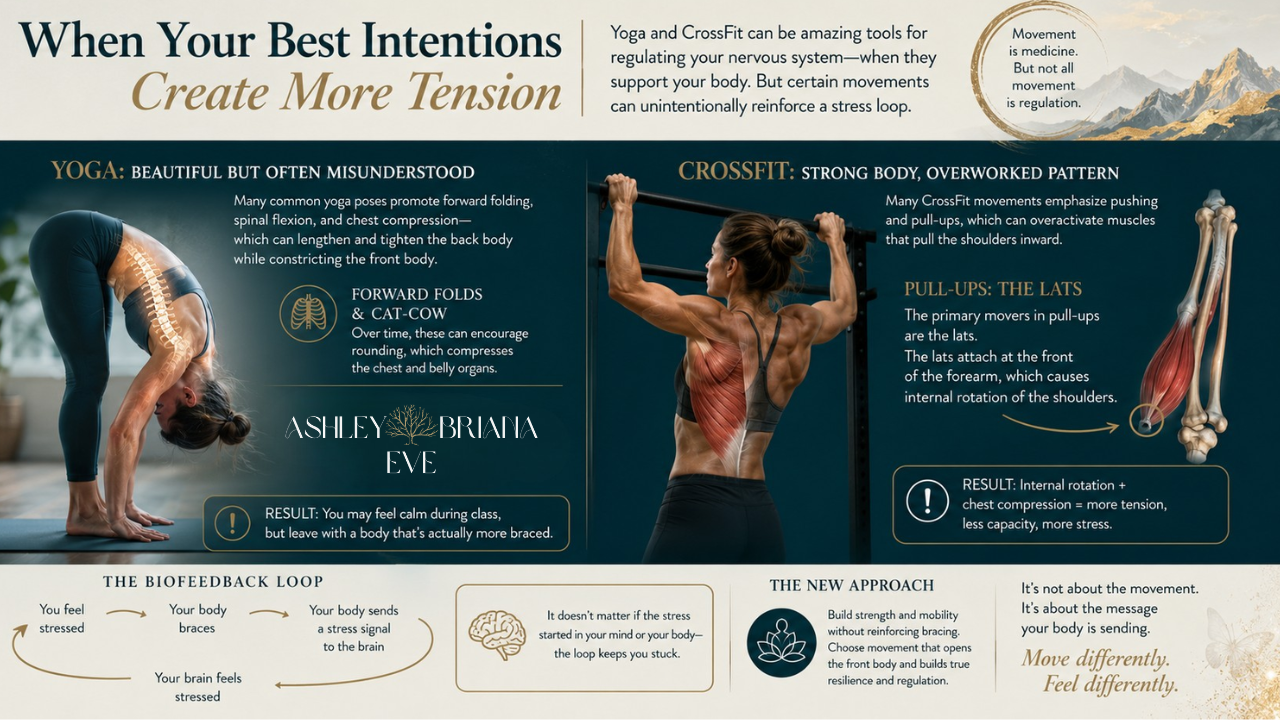
To reduce stress and anxiety, people do everything they’re told to do. They exercise. They get the walking desk. They practice yoga. They join a local fitness class. They learn breathwork. And lasting results stay out of reach.
Why?
Because they’re still living in bodies organized around chronic stress. Still living in misaligned bodies. And a nervous system doesn’t exist in isolation — it exists within a body that has adapted over years to repetitive movement, protective muscle tension, old injuries, breathing patterns, and posture.
If those adaptations never change, we shouldn’t be surprised when the stress patterns keep returning.
Think about what a body actually accumulates over a decade of modern life. Thousands of hours in a chair, hips folded, upper back rounding toward a screen. A habitual breath that has become shallow and high in the chest because that’s what a mildly braced, mildly vigilant body breathes like. Muscle tension that started as protection after an injury or a stressful season and simply never switched off. A posture that has slowly organized itself around holding, guarding, and getting through.
None of that is character. None of it is weakness. It is adaptation — the body doing exactly what it is designed to do, which is to change its structure in response to how it is repeatedly used. But adaptation is neutral. It responds to what you practice, and most of us have been practising chronic stress, in the same seated position, for years. The body has become very good at being stressed. It has built the architecture for it.
And here is the part that matters for anyone who has tried to think their way out of that state and found they couldn’t. A body organized around stress doesn’t just hold stress. It generates it. It sends a continuous stream of signals upward that the brain reads as low-grade threat, regardless of what is actually happening in your life. You can have a perfectly good day and still feel vaguely braced, because the structure itself is producing the signal.
The Vagus Nerve Example
Let me show you how concrete this is, using the vagus nerve — because so many of the people I work with have found their way to it. They tried everything else first, nothing stuck, and then they discovered this nerve that runs from the brainstem down through the neck and into the body, regulating the entire stress response. The physical highway of the mind-body connection.
So they decide to work on Vagal Tone. They start with yoga for stretching. CrossFit for strengthening. A serious routine, fully committed. But nothing customized to their body and how their unique body has been taught to brace for stress, even when stress isn’t present.
Here’s the catch. The vagus nerve travels through the neck. When the head sits forward and the shoulders round — the posture nearly all of us have built from years at a desk, on a phone, under stress — that position physically compresses the region the nerve passes through. Researchers have documented forward head posture creating vagus nerve compression directly.
And a lot of well-meaning movement quietly reinforces that exact posture. Yoga flows are heavy on poses, or asanas, which promote stretching an already over-lengthened upper back and tightening an already tight chest. CrossFit heavily focuses on pressing (pushups) and pull-ups. Most people don’t know this however the latissimus dorsi, or "lats," the primary mover in pull-ups attach at the front of the upper arm and internally rotate the shoulder, rolling it forward. Making the very problem you are attempting to fix worse. Then you finish training and sit in your car or back down at the desk, chest tightening, head drifting toward the screen.
The effort is real. The intention is good. But without alignment, the effort feeds the very pattern you’re trying to undo.
This doesn’t mean movement is the problem. Movement is medicine — I have built a life around that conviction. It means we have to ask a more precise question than we’re used to asking: is the movement I’m choosing restoring balance, or reinforcing the same adaptations I’m hoping to change? The same exercise can do either, depending entirely on the body that’s doing it and the alignment it’s done with.
A forward fold is restorative for a body that is over-extended and braced backward. It is reinforcing for a body that is already collapsed forward. The movement is identical. The effect is opposite. This is the nuance that gets lost when wellness advice is delivered as a universal prescription — do this pose, try this exercise, follow this routine — with no reference to the specific structure of the specific body receiving it.
Lasting change isn’t just about changing your thoughts. It’s about changing the information your body sends to your brain every moment of every day.
Your Body Changes Your Thoughts
This is the piece that reorganized my entire understanding of health, and it became one of the foundations of my work through the Radical Happiness Movement and The Restoration of Body Intelligence.
We tend to assume the traffic runs one direction — that the brain is the command centre issuing instructions to a body that obeys. But the vast majority of the vagus nerve’s fibres are afferent, meaning they carry information from the body up to the brain, not the other way around. Somewhere around eighty percent of the signalling is body reporting to brain. Your physiology is not primarily receiving orders. It is primarily sending reports. And the brain is listening far more than it is dictating.
Which means the state of your body is not a downstream consequence of your mental state. It is very often the cause of it. A body held in chronic tension and postural misalignment is sending a continuous upward stream of information that the brain interprets as low-grade threat. The brain, doing its job, generates the mental and emotional weather to match: the vigilance, the anxiety, the difficulty settling, the sense that something is wrong even when nothing in particular is.
This is why you can do a great deal of psychological work — genuinely good, genuinely insightful work — and still feel stuck. You are working on the output while the input continues unchanged. You are trying to reason with a brain that is receiving a steady signal of unsafety from the body it lives in. The thoughts are downstream. The body is upstream. And you cannot win an argument with your own physiology by thinking harder.
Your body quite literally changes your thoughts. Not metaphorically. Not poetically. Mechanically, continuously, through a nerve whose primary job is to keep the brain informed about the state of the body it is responsible for.
What Restoration Actually Requires
If the body is upstream, then restoration has to begin there. Not instead of the mental and emotional work — alongside it, and underneath it, as the foundation the rest can finally hold on.
In practice this means changing the information the body sends, by changing the body itself. Opening the front line of the body that chronic sitting and stress have shortened. Restoring length and strength to the deep postural muscles that hold the head and shoulders in a position that gives the nerves and the breath room to function. Retraining a breath that has become shallow and defensive into one that is slow, low, and safe. Choosing movement for how it reorganizes the structure, not for how hard it makes you work or how much it lets you punish yourself in the name of discipline.
As the structure changes, the signal changes. As the signal changes, the brain’s reading of your safety changes. And as that reading shifts — slowly, through repetition, through consistent new information — the nervous system begins to settle into a baseline it has not known in years. Not because you talked it into calm. Because you changed the physical reality it was responding to.
This is what I mean, very literally, when I say alignment in the mind begins with alignment in the body. You are not a mind that happens to have a body. You are one integrated system, and the structure is the ground floor. When the ground floor is compressed and braced and sending threat upward all day long, no amount of work on the upper floors reaches the thing that is actually holding you in stress.
Restoration isn’t more effort. It’s the right alignment — working with the body’s actual structure instead of against it. And when you do, the change doesn’t feel like one more thing you’re managing. It feels like something finally letting go.
If you would like to discuss custom packages that work best for your body and goal please email [email protected].
Ashley
P.S- If you are a paid subscriber to Substack keeps your eyes open for the 30 Day Radical Happiness Journey which begins tomorrow, July 8th. This is designed to be a course format with trainings taking up no more than 10 minutes and practices being under 10 minutes daily. Lasting sustainable change after burnout can be simple. I’ll show you the path to radical happiness in this new journey!
Ashley Briana Eve is the founder of the Radical Happiness Movement and the creator of The Restoration of Body Intelligence. She works at the intersection of nervous system science, structural alignment, Human Design, and somatic practice.
