The Psychology Behind Fake PR Stunts — And Why It Works
May 09, 2026
Do you ever think that inauthentic PR stunts or media manipulation works on everyone but you? If you find yourself nodding along then you need this article more than those who realize they are being manipulated. It works on all of us.
Now, let’s get one thing out of the way first: the question isn’t whether inauthentic PR is ethical. It isn’t. The question — the more interesting, more useful, more urgent question — is why it works anyway.
Every time a celebrity emerges from a scandal with a carefully choreographed comeback, every time a brand makes a public apology that reads like it was drafted by seventeen lawyers, every time a company suddenly “discovers” its values align with whatever social cause is trending, and every time your favourite celebrity shows up at a hospital with a camera crew or makes a donation under their real name — someone in a conference room knows exactly what they’re doing. And it works. Reliably. Repeatedly. On people who consider themselves intelligent, media-literate, and impossible to manipulate.
This is what the PR industry has known for decades and what the public is only now beginning to grasp: inauthenticity doesn’t need to be invisible to be effective. It just needs to be psychologically timed.
AUTOPSY FILE #001: The Blake Lively Problem
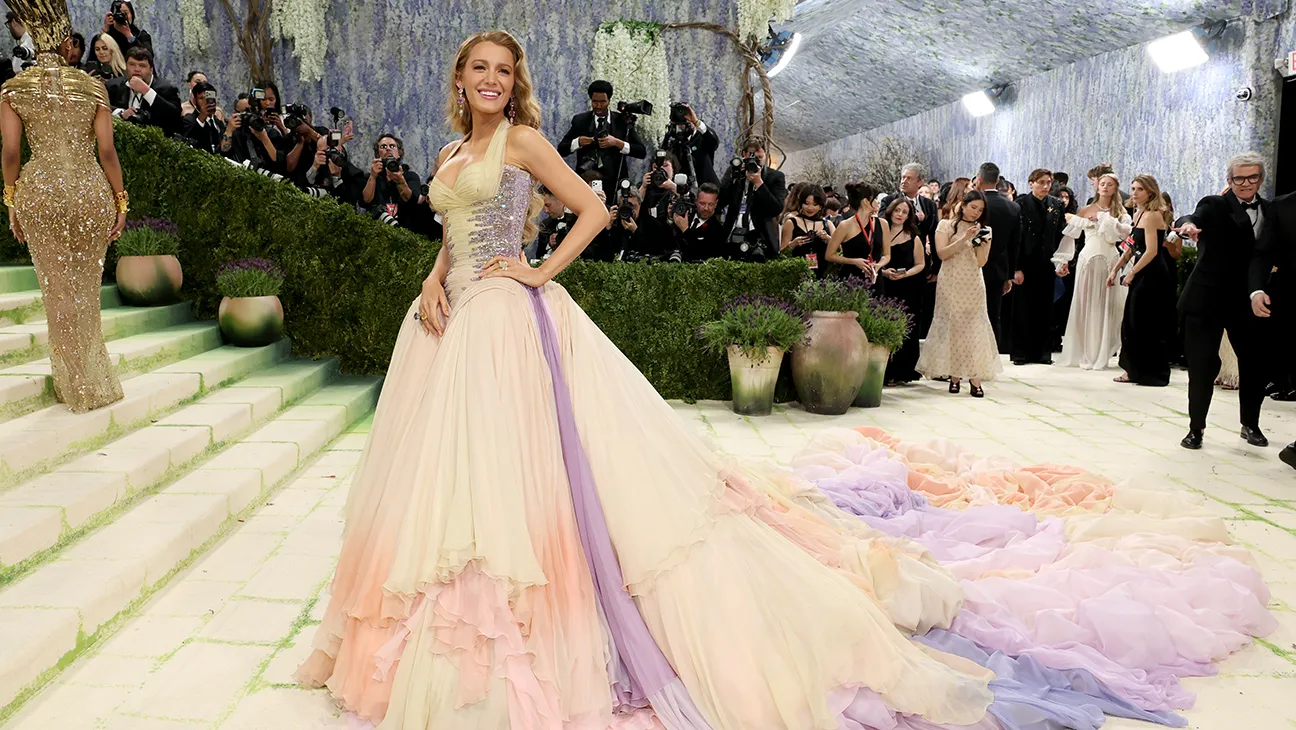
Two hours after settling the lawsuit with Wayfarer & TAG PR, Blake Lively walked into the Met Gala. A $100,000-a-seat ball. Meanwhile, her Blake Brown Beauty brand was handing out free hair care products on the streets of New York.
This was a textbook attempt at a peak-end play — a strategy borrowed from behavioural psychology that says people don’t remember experiences in their entirety. They remember the peak moment and the final moment. Her team understood that. The settlement needed to become the forgettable middle. What you’d remember instead was supposed to be the ending: her triumphant return, beautiful gown, back in her natural habitat. The princess, refreshed. A little softer, a little more “I’m actually really shy” than the era before. The lawsuit, in theory, dissolves into the background noise of a comeback narrative.
It didn’t work — and not because the strategy was wrong. It didn’t work because the ending they chose directly contradicted the identity she’d just publicly claimed.
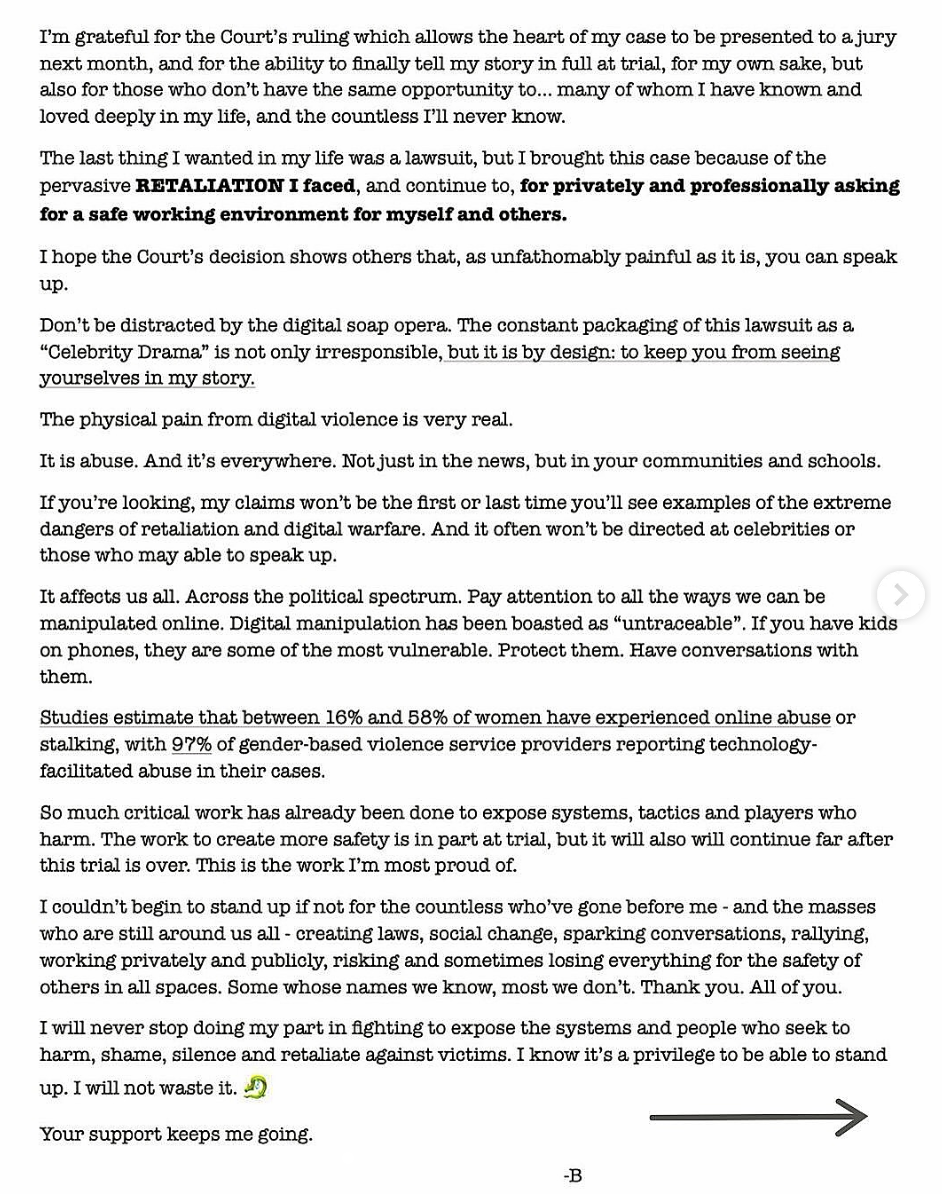
Lively had spent months saying she would never stop fighting for women. That framing was load-bearing. It’s what gave her side of the lawsuit its moral weight. So when the fight was over, the peak-end play demanded an ending that honoured that identity. Instead, she went to a ball that costs more than most people’s annual salary and handed out products on a sidewalk.
The alternate play was sitting right there, unused. It was Mother’s Day weekend. She had a hair care brand and a settlement and a public statement about fighting for women. A visit to a women’s shelter — products in hand, a short speech about what she’d learned, a genuine moment of redirection — would have been calculated, yes. Her detractors would have called it performative. They would have been partially right. But here’s the thing: calculated in a direction that doesn’t make you a hypocrite is still better PR than authentic in a direction that does. Going to a women’s shelter after saying you fight for women is at least internally consistent. Going to the Met Gala isn’t.
The peak-end play failed because the ending they wrote contradicted the character they were trying to rehabilitate. The strategy was sound. The execution was tone deaf (which ironically is on brand). And in PR, those are two very different autopsies.
Cause of Death: Wrong Ending on the Right Strategy (don’t sue me Blake, it’s not a threat)
The Psychology Behind the Con
Inauthentic PR doesn’t work through deception alone. It works through a layered stack of cognitive vulnerabilities that are, frankly, baked into how human brains process information. The PR industry didn’t invent these. They just learned to exploit them with surgical precision.
The Illusory Truth Effect is the foundation of almost every PR rehabilitation arc. Repeat something enough times — across enough channels, in enough contexts — and familiarity starts to read as truth. This is why brands in crisis pivot immediately to positive messaging. The goal isn’t to argue. It’s to flood the zone. You don’t fight the narrative. You drown it in a louder one.
Emotional contagion does the rest of the heavy lifting. When you see imagery of someone doing something good — volunteering, giving, showing up — your nervous system responds before your critical mind can. You feel warmth. That feeling gets associated with the brand. The critical thought — “wait, didn’t they just—” comes a half-second too late, and now it has to fight uphill against an emotional response that’s already been logged.
Social proof closes the loop. If enough people around you seem to have moved on — if the brand’s comments are full of positivity, if their sales numbers hold, if the press cycle shifts — your brain interprets that consensus as a signal that you should update your position. We are, at our core, herd animals. The perception of forgiveness creates the conditions for actual forgiveness.
Still skeptical? Consider how many people watched Taylor Swift visit children’s hospitals, make headline donations, and show up as the patron saint of female solidarity — and felt nothing but warmth. Not because they were naive. Because the imagery was doing exactly what it was designed to do. The emotional response landed before the critical thought could catch up.

It wasn’t until the text messages surfaced in the Blake Lively and Justin Baldoni lawsuit that a significant portion of her audience found themselves doing the uncomfortable math. Oh. She isn’t who I thought she was. The PR had been working perfectly — right up until it couldn’t anymore.
That gap between “I would never fall for that” and “I just did” is exactly where inauthentic PR lives. And it’s a lot narrower than most people want to admit.
AUTOPSY FILE #002 — Pepsi, Kendall Jenner, and the Protest Ad That Broke Its Own Brain

In 2017, Pepsi released an ad in which Kendall Jenner defused a protest — tense, racially charged, unmistakably evoking Black Lives Matter imagery — by handing a police officer a can of soda. The backlash was immediate, volcanic, and deserved. Pepsi pulled the ad within 24 hours.
But the failure wasn’t just aesthetic. It was psychological — and understanding why it collapsed tells you more about how inauthentic PR works than almost any success story can.
Inauthentic PR succeeds when it operates below the threshold of conscious scrutiny. It moves fast, feels warm, triggers an emotional response before your critical brain can engage. The Pepsi ad did the opposite. It was so tonally dissonant — so jarring in the gap between what it was referencing and what it was selling — that it activated critical thinking rather than bypassing it. Psychologists call this reactance: when an attempt to influence someone is too obvious, too clumsy, too transparently manipulative, it triggers a defensive rejection response. You don’t just ignore it. You push back harder than you would have if they’d never tried.
Worse, the ad managed to alienate the exact audience it was trying to attract through a phenomenon called identity-protective cognition. People who were personally invested in the protest movements being depicted didn’t just find the ad tone deaf — they experienced it as a direct threat to something they held as core to their identity. And when people feel their identity is under threat, they don’t disengage. They mobilize. The ad didn’t create passive indifference. It created active, organized, very loud opposition.
Here’s the part people forget though: it still worked, partially. Pepsi’s name dominated the cultural conversation for a week. Kendall Jenner’s team issued an apology that generated its own sympathy cycle. And the ad itself became so embedded in pop culture that Pepsi gets name-dropped in media literacy conversations — like this one — indefinitely. The gesture failed catastrophically. The brand visibility didn’t.
This is the ceiling of inauthentic PR: when the gap between gesture and substance is too wide, when the manipulation is too naked, when the audience being targeted is too personally activated — the mechanism breaks. But even when it breaks this publicly, the name stays in the room.
Cause of Death: Gesture outran credibility
Why Being “In On It” Doesn’t Make You Immune
Here’s the part that trips people up: knowing that PR is manufactured does not protect you from its effects. This is probably the most important thing I can say in this piece, and the thing that most media literacy conversations get completely wrong.
We assume that awareness equals immunity. It doesn’t. The psychological mechanisms at work — emotional contagion, repetition- based familiarity, social proof — operate largely below the threshold of conscious thought. Your prefrontal cortex can be fully aware that a brand’s apology was drafted in a crisis communications firm at 2am, and your limbic system will still respond to the imagery of their CEO looking contrite on camera.
This is why “I know it’s fake” is not a defence strategy. It’s a starting point.
So What Do You Actually Do With This?
You don’t opt out of consuming media. You don’t stop engaging with brands. What you do is develop the reflex to pause at the emotional response — that warmth, that relief, that sense of “okay, they’ve changed” — and ask: what am I actually looking at here?
Is there structural change, or is there imagery of structural change? Is there accountability, or is there the performance of accountability? Is the gesture proportionate to the harm, or is it strategically sized to generate a specific kind of press?
You don’t need to be paranoid. You need to be precise.
The brands and public figures who run inauthentic PR campaigns understand — better than their audiences do — how human psychology actually works. Closing that gap is not about becoming a cynic. It’s about becoming a sharper reader of the room.
That’s what media literacy actually is. Not distrust as a default.
Precision as a practice.
Ready to go Deeper? Learn to Autopsy Any PR Move in Real Time
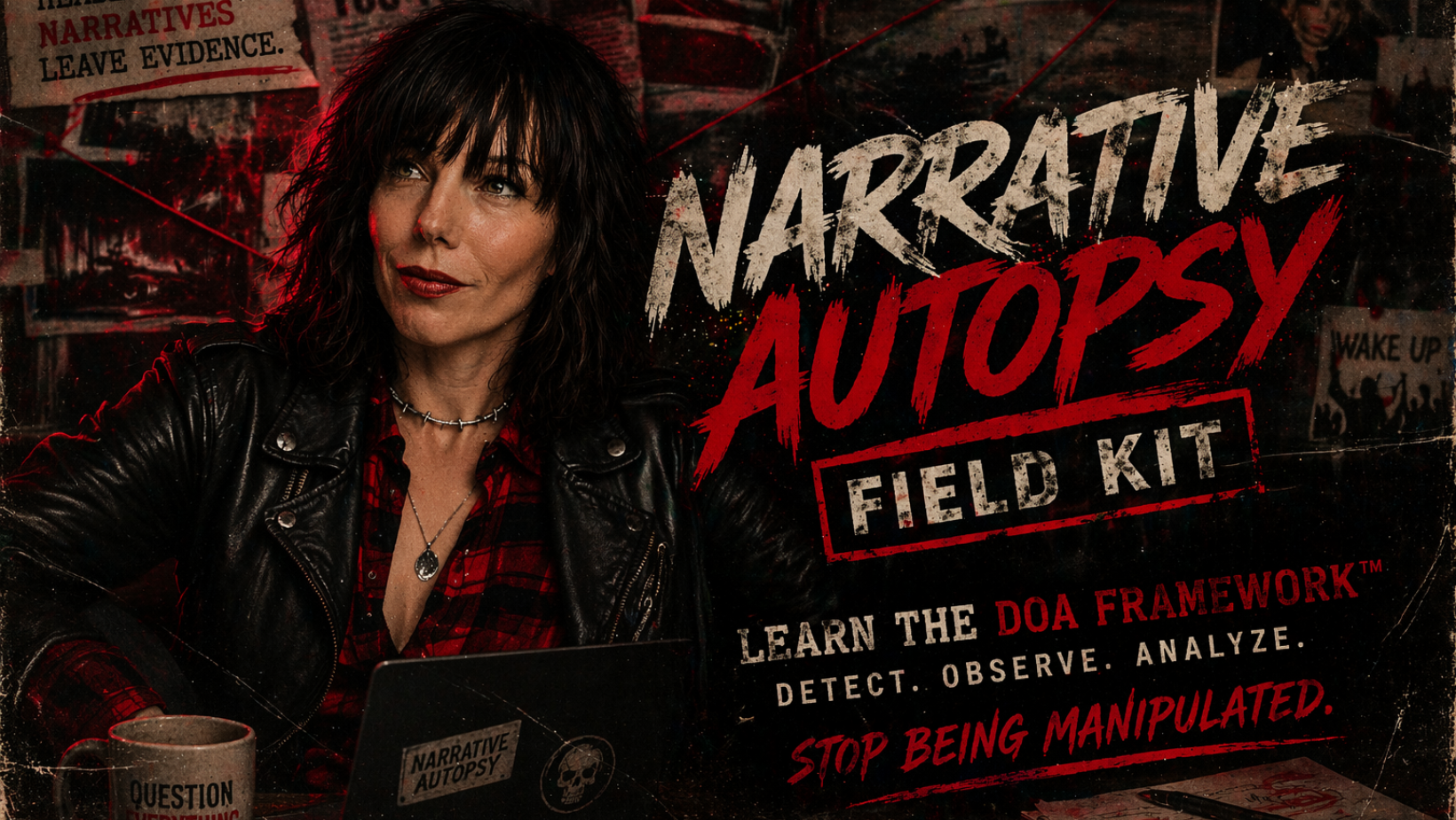
People ask me all the time if I teach media literacy.
I don’t have a university classroom. What I have is better — the Narrative Autopsy Field Kit: your practitioner’s guide to reading brand psychology, crisis PR, and media manipulation before it reads you.
If you are tired of being manipulated get the Field Kit here → https://www.ashleybrianaeve.com/narrative-autopsy-field-kit
Ashley
© The Narrative Autopsy · All autopsies performed without anesthesia.
