Jay Shetty's Shameless Self Promotion in Hayden Panettiere Post
Aug 24, 2026
Let’s first say this: The way the bots and burner accounts struck back after my Instagram post started going viral it’s obvious I hit a nerve in Shetty’s camp. His camp is very well known, through direct experience of journalists as well as through ex-employee claims, to take reputation management, and aggressive protection of it very seriously.
Today I’m going to break down the psychology of his Instagram post “honouring” Hayden Panettiere. And for those defending him: Even if we put PR or manipulative tactics aside a memorial post should NEVER be focused on how great the person thought you are. It’s simply gross, yet for someone that got to where he is through blatant plagiarism and lying (allegedly) it is also not shocking.
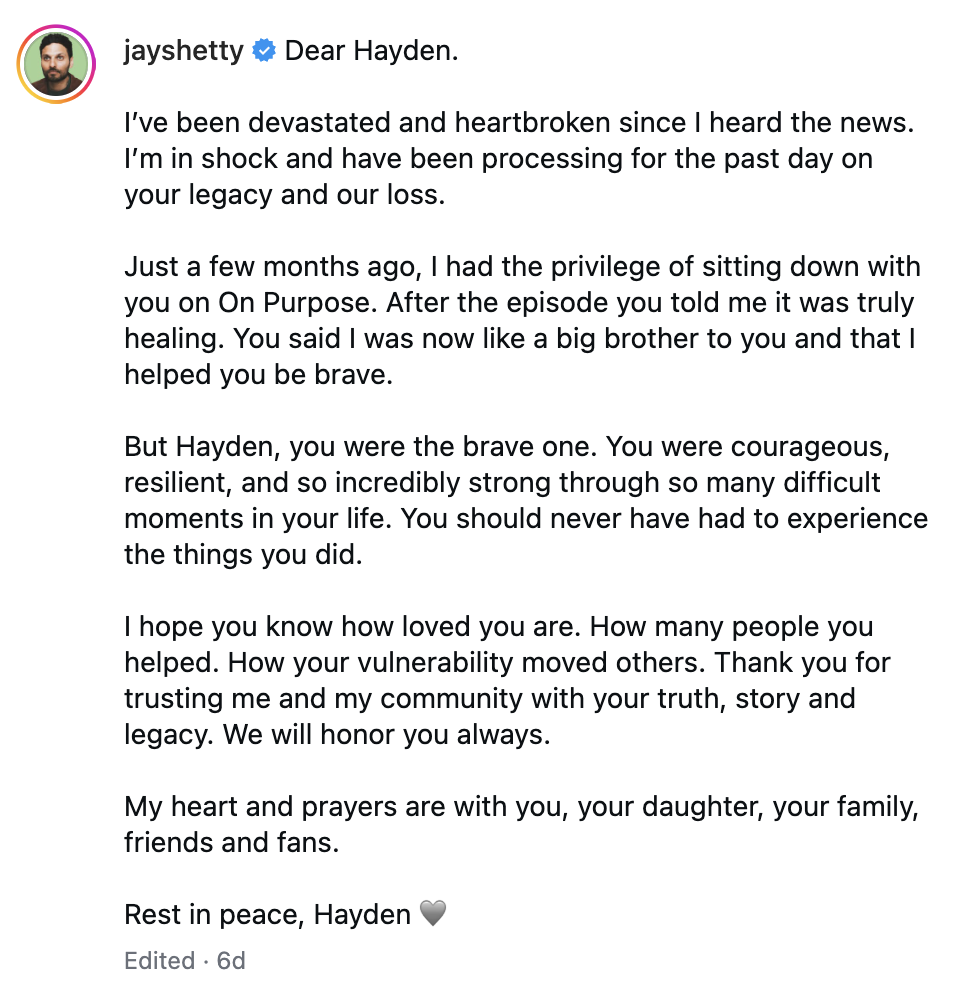
It’s All About “I”
Read this post once and it looks like grief. Read it twice and you start counting the “I”s.
“I’ve been devastated and heartbroken.”
“I’m in shock.”
“I had the privilege of sitting down with you.”
“I hope you know how loved you are.” — worth noting, Hayden has spoken publicly about not feeling loved or safe for much of her life.
“I helped you be brave.”
For someone with a brand this tightly managed, this isn’t sloppy writing. It’s a pattern, and patterns in managed brands are rarely accidental. That’s where the sentence keeps returning the reader’s attention, over and over, regardless of what the sentence claims to be about.
I know the counter-argument already, because I’ve seen the same clip everyone else has: she looked at ease in that interview. She said warm things about him on camera. I’m not disputing that the moment was a good experience for her. What I’m questioning is what happens to a real moment once it gets repurposed — and here, the video could have spoken for itself. It didn’t need narration. It didn’t need three quotes pulled out and re-delivered in his own voice, days after her death, in a post that opens with his shock and his grief and his privilege of knowing her.
This isn’t about him…. unless it is.
The mechanism: quoting the dead to promote the living
Here come the lines that do the actual work in this post to expose the underlying motivation, and it’s not the parts that look like grief. It’s the three places where Jay Shetty quotes Hayden Panettiere praising him.
She apparently told him he was “like a big brother.” That he “helped her be brave.” That the episode was “truly healing” — for her.
In a tribute post, quoting the deceased complimenting you is a choice. And it’s a specific kind of choice. It’s the choice of someone who has spent years building a brand on being the guy who makes broken people feel healed, and who — even in a post that is ostensibly about her death — cannot resist using her own words to reinforce that brand promise one more time.
She can’t confirm it. She can’t add context. She can’t tell you what else that conversation contained. The quotes just sit there, doing PR for him, permanently, because she’s not here to push back.
It’s very similar to her mom. Her mom is now claiming that SHE was in fact the one that chose to pull away because of severe concerns over Hayden's on-and-off relationship with Brian Hickerson, whom the family had long tried to get out of Hayden's life. But that’s not what Hayden said when she was alive.
Or how about Neutrogena. Taking no responsibility yet saying they understand they made her feel “unsupported.” She claimed she was more than unsupported.
Everyone speaking for Hayden when she can’t speak for herself. It’s genuinely sad yet interestingly enough the only one being defended in this behaviour is Jay. Hard to not want to praise him for stellar branding that is holding up even within this mess of a statement.
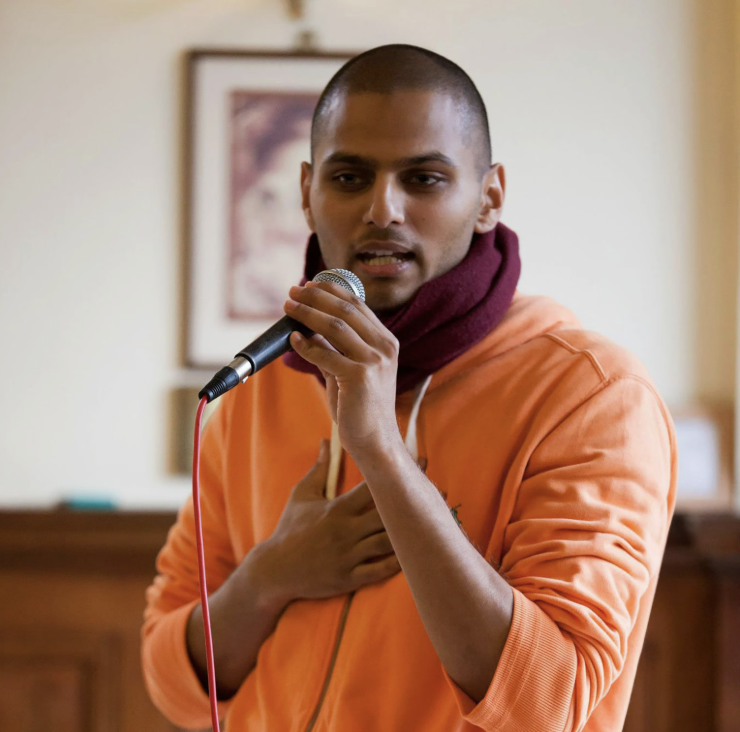
The nice, sweet (fake) monk Jay Shetty who has built an empire around being the guy that makes you feel safe, seen, and healed. How could you question that smooth voice and baby blues? A monk wouldn’t lie to you. And it holds up, as long as you aren’t the one on the other side of being plagiarized I suppose.
For context, his monk outfit is an Abercrombie hoody and scarf.
Jay Shetty Centres Himself Once Again
“My community” is another line to flag.
The sentence that should stop you cold isn’t the devastated-and-heartbroken opener. It’s this one:
“Thank you for trusting me and my community with your truth, story and legacy.”
That’s not a sentence about her. That’s a sentence about stewardship — an assertion that her story, going forward, belongs partly to his platform. Her disclosure gets reframed as content that was entrusted to him. That’s not the language of grief. That’s the language of an asset transfer.
Grieving someone means missing them. Stewarding their “legacy” means you now have ongoing rights to narrate it. Those are two different relationships, and this post quietly asks you to accept the second one while performing the first.
Track where the post’s attention actually goes. It keeps pulling back to Jay’s vantage point on her: what she said about him, what she gave him, what she trusted him with, how she made him feel like a big brother. Even the tribute is shaped around his experience of her.
A eulogy centres the person who died. A humblebrag centres the person still standing at the podium. This post is doing the second thing in the visual grammar of the first.
The Psychology of his Post
The “I” flood → self-referential framing
Psychologically, where you put the subject of a sentence is where you put the emotional centre of gravity. Starting almost every sentence with “I” trains the reader’s attention onto the narrator, even while the content claims to be about someone else. It’s may not be conscious manipulation necessarily — it’s what happens when someone’s default frame for any experience, including someone else’s death, is “how does this connect to me.” The reader absorbs it as sincerity because it’s wrapped in emotional language, but structurally it’s self-centering. In Jay’s situation I find it hard to believe it isn’t intentional as he has one of the most heavily managed and controlled brands in 2026.
Quoting her praise of him → borrowed authority
This is a classic social-proof move, just deployed in a grief context where people don’t expect to see it. Normally “someone said I changed their life” is a testimonial — used in sales pages, bios, press. Here it’s doing the exact same job, just laundered through eulogy language so it reads as tender instead of promotional. The psychological trick: testimonials feel more credible coming from someone who can’t be cross-examined. A living person’s praise can be walked back, contextualized, disputed. A dead person’s praise is permanent and unfalsifiable — which makes it, unfortunately, more useful as “proof” for a brand, not less.
Timing → weaponized social taboo
The tactic isn’t just what’s said, it’s when. Criticizing a grief post carries a strong social penalty — you look cold, opportunistic, cruel. That taboo is precisely what makes grief the safest possible container for brand messaging. Nobody fact-checks a eulogy. Nobody says “source?” to a man crying about his big-brother energy. The taboo against criticizing mourning functions as cover, whether or not that’s consciously why he chose the format.
Jay Shetty’s PR Teams Response (allegedly)
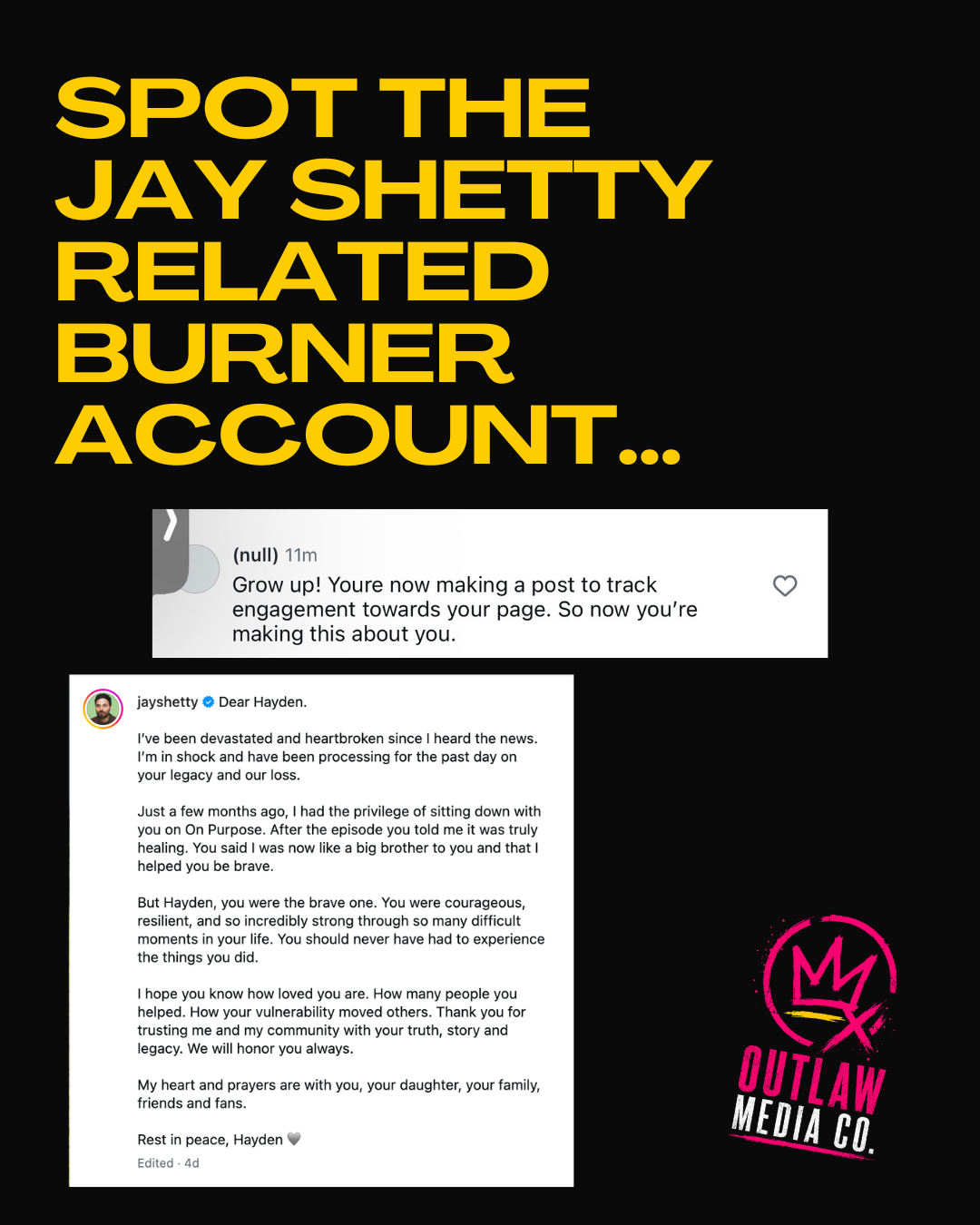
Here’s the part that didn’t make it into the carousel, because it happened after.
Once that post crossed roughly 20,000 views, I got hit with a wave of comments that had a very specific shape. Same accusation, back to back, in a tight window — “grow up,” “you’re the one making this about yourself,” “you’re the real grifter here.” Then the accounts deleted. Then new ones showed up saying almost the same thing. Then, within about two hours, it stopped completely and never came back.
That’s not organic disagreement. Organic disagreement doesn’t clock in and clock out. What I was looking at has a name: coordinated inauthentic behaviour — accounts built to appear, push one message hard, and disappear before anyone can scrutinize who’s actually behind them. The relay structure, where one account vanishes and another picks up the exact same line, exists specifically so no single profile accumulates a visible history. It’s designed to look like a spontaneous crowd. It isn’t one.
If you followed my coverage of Blake Lively & Ryan Reynolds, which earned me a subpoena from hitting too close to home, you may recognize what this is: astroturfing. Seed a new narrative aggressively in a way that makes it appear real.
But the message itself is the more useful part to name, because you’ll see it everywhere once you know it: DARVO — Deny, Attack, Reverse Victim and Offender. Yep, you read that right. DARVO frequently exists and is actively used as a public relations (PR) and crisis management strategy. It forces the public and media to debate the motives of the accuser rather than the evidence against the offender.
Notice what the pushback didn’t do. It didn’t defend the actual behaviour. Nobody argued that quoting a dead woman’s praise in a tribute post was appropriate. Actually, I would say the real people disagreeing with me were obvious because THAT is exactly what they did. They defended Jay and his behaviour.
Instead the suspicious activity skipped straight past the behaviour and went for me — questioned my motives, accused me of self-promotion, flipped the frame so that critiquing a brand’s PR tactic somehow made me the opportunist. That’s the whole mechanism. Deny the substance, attack the source, reverse who’s the victim. It doesn’t need to win the argument. It just needs to make the audience question the person criticizing Shetty.
And that’s the through-line for this entire piece, honestly. How million dollar brands (and her mother) have leveraged her death in their own interest.
Neutrogena managed risk with feelings-language instead of ownership. Shetty managed opportunity by quoting a dead woman’s testimonial he couldn’t be challenged on. A mother who has a new explanation for why her and her daughter cut off contact. Three individuals using this opportunity for themselves.
If your instinct is that this reads as harmless or not even possible to be his intention with the post, that’s not naivety — that’s the mechanism working exactly as designed. Branding at this level isn’t built to convince you once. It’s built so that when something genuinely manipulative happens, your brain rejects the read before it rejects the brand.
That’s cognitive dissonance: holding “I trust this person” and “this person just used a death for brand equity” at the same time is uncomfortable, and the discomfort gets resolved by keeping the belief that’s cheaper to keep.
There’s a second layer under that — believing you were manipulated isn’t just updating a fact, it’s admitting you were an easy mark, and most people will defend their self-image before they defend the truth.
None of this makes you gullible. It makes you human, and it makes you exactly the audience this kind of branding is engineered for.
It’s human nature… exploited by million dollar brands.
I will be doing a long form video breakdown, and I joked on Instagram for every bot or burner attack I get I will create a new piece of content pointing out that Jay Shetty is a fraud.
ashley
