
Exercise, Depression & the Nervous System: Exercise for Mental Health
Aug 10, 2026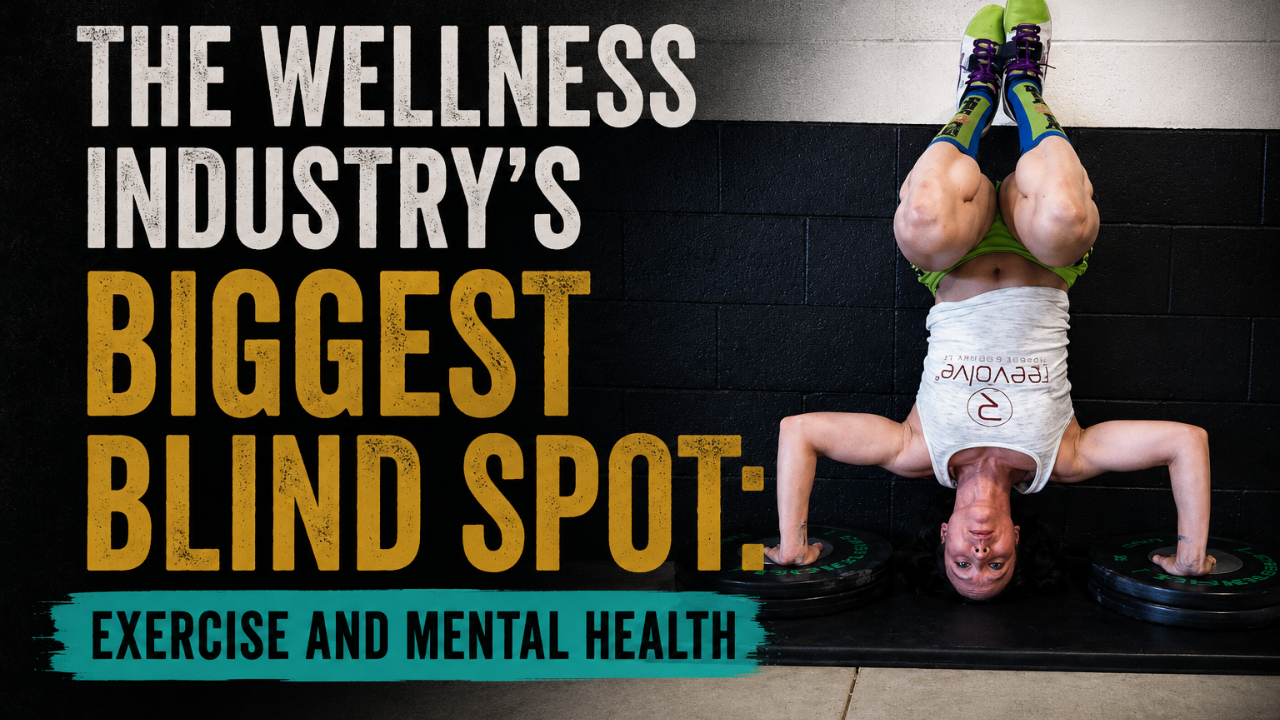
I’ve spent the last six months watching the wellness industry quietly backslide into something we should have left behind a decade ago.
GLP-1s pushed as the miracle that help women maintain an unrealistic level of thinness (flashbacks of fen phen, anyone?). The return of “skinny at all costs,” just in better packaging. And a new wave of content telling women in perimenopause that cardio is “junk volume,” that running or CrossFit will make them fat, and that the only legitimate training is lifting heavy, with no cardio, otherwise their muscles will turn to dust as they fall down the stairs from weakness.
Here’s the quiet assumption underneath all of it: you are still not enough or doing it right. But someone has a magic fix for that. And in these marketing tactics we completely forget about the mental health benefits of exercise.
Mood doesn’t count. Sleep doesn’t count. Stress reduction doesn’t count. Enjoyment or flow state within activities you love don’t count. Flourishing doesn’t count.
And, before anyone comes in here saying that this is an attack on naturally thin women. It’s not. The entire point is celebrating our UNIQUE bodies, our health, and rejecting that we need to fit into what trillion dollar companies tell us we should look like.
I’m done being neutral about that.
Today we’re talking about exercise as a mental health intervention — your mood, your sleep, your executive function, your capacity to believe you can do hard things. Not as a body project. As a brain and nervous system support system. Because health isn’t vanity. It’s the foundation everything else stands on. You cannot access accomplishment, positive emotion, or any version of flourishing from a dysregulated, depleted body.
Because here’s the thing almost nobody in the wellness industry will say plainly: we’ve been selling exercise as a punishment for eating, a shame ritual for not meeting society’s standards of thinness, and a tool for shrinking, when the actual research — real, replicated, peer-reviewed research — says it might be one of the most powerful mental health interventions we have access to. Not “might help a little.” Large effect sizes. Comparable-to-medication effect sizes in many cases. And almost nobody is leading with that.
This is the first piece in my foundation series, because before we talk about flourishing, before we talk about identity, we have to talk about capacity. And capacity starts in the body.
The depression data
In February 2024, a large network meta-analysis in the BMJ (Noetel et al.) pooled dozens of studies comparing different treatments for depression. The finding: exercise is an effective treatment for depression. Walking, jogging, strength training, and yoga performed best — especially at higher intensity.
A separate 2023 meta-analysis found exercise decreased depressive symptoms with what researchers call a large effect — in plain terms, a real, clinically meaningful shift, not a subtle nudge.
Here’s the nuance that matters: exercise is not flatly “better than” antidepressants, and I’m not telling you to stop taking your prescription. Head-to-head comparisons show exercise and medication producing comparable improvement in mild-to-moderate depression. One study found remission rates of 43% with structured running versus 45% with antidepressants — essentially a tie.
For mild-to-moderate depression, exercise is a legitimate, evidence-based treatment in its own right. For severe depression or anything involving safety risk, that’s a work-with-your-doctor situation. Both things are true at once.
Why it works — the mood mechanics
There’s a biological piece here. Movement influences dopamine signalling, supports BDNF (brain-derived neurotrophic factor — essentially fertilizer for your brain cells), and interacts with your stress hormone system in a way that, over time, builds resilience to stress rather than reactivity to it.
But there’s a non-chemical piece that gets skipped constantly: self-efficacy.
Every time you do a hard thing on purpose, you give your nervous system evidence that you’re capable. That evidence compounds — and it doesn’t stay in the gym. It shows up when your inbox is on fire, when your kid is screaming, when your brain insists you can’t handle today. Some part of you now has proof that you can do it, that you can get up again for one more rep, because you did something hard on your own terms, recently.
Sleep — the piece everyone underestimates
Exercise, particularly earlier in the day and at real intensity, improves sleep architecture. Research shows more time in deep sleep, and a better-regulated cortisol rhythm.
Cortisol is supposed to peak in the morning and drop through the day. For a lot of us living in chronic overwhelm, that rhythm flattens out. It stops dropping the way it should. That flattening is linked to poor sleep and worse mood regulation. Especially for women in perimenopause who may be struggling with disrupted sleep due to night sweats or emotional dysregulation due to fluctuating hormones, this is a huge win!
Movement is one of the few free, accessible tools that helps retrain that rhythm — not overnight, but measurably, and often within just a few weeks of consistent training.
Cognition — why this matters especially if you have ADHD
Executive function — planning, focus, task-switching, impulse control — shows up in this research too. Aerobic exercise has a modest but real effect on executive function, and resistance training shows the strongest overall effect on mood specifically. Different tools, overlapping benefits.
This is why I never talk about exercise with my clients as a body project. I talk about it as a brain project. Your focus on a Tuesday afternoon has more to do with what you did with your body on Monday than most people realize.
The overwhelm connection
There’s a concept in stress research called allostatic load — the cumulative, physical wear and tear that chronic stress puts on your body. Not a metaphor. Measurable: elevated blood pressure, a disrupted cortisol rhythm, low-grade inflammation, and documented effects on the hippocampus and prefrontal cortex — the brain regions responsible for memory and executive function.
Chronic overwhelm is not just a feeling. It’s a physiological state with a biological signature.
Here’s the hope in that: several of those biomarkers are directly responsive to behavioural change. Blood pressure starts dropping within weeks of consistent aerobic work (examples could include brisk walking, running, swimming laps, cycling). Cortisol rhythms start normalizing with movement and better sleep. Your overwhelm is not a fixed trait — it’s a state your body can be coached out of, and that coaching starts in the body, not only in your thinking.
Why this is where I’m starting
So when I say “strong.ER after 40” I don’t mean only a number on a barbell. I mean building a body and a nervous system that can actually hold the life you’re trying to build — especially if you’re moving through perimenopause, managing ADHD, or living with overwhelm that’s been running the show longer than you’d like to admit.
This isn’t simply about becoming an athlete, although I help clients with that too. It’s about becoming someone with enough capacity to flourish.
If any part of this resonated — especially the overwhelm section — that’s exactly what my upcoming Biology of Overwhelm, with an optional athlete upgrade, is built for: body-based, not just a mindset course, because your overwhelm isn’t only in your head. More on that soon.
Coach ABE
